

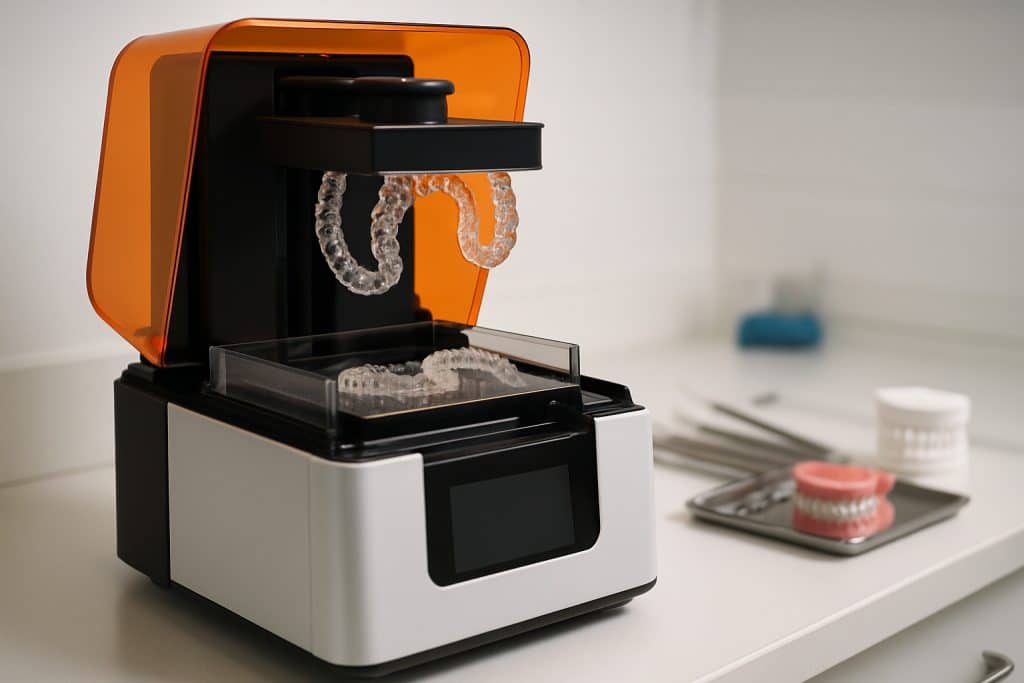

3D Printed Orthodontic Appliances: How They’re Designed, Made, and Tested
3D printed orthodontic appliances are custom-made dental devices created using digital scanning and additive manufacturing technology. These innovative appliances are changing orthodontic treatment by offering more precise, comfortable, and efficient solutions for straightening teeth.
What are 3D printed orthodontic appliances?
- Definition: Dental devices manufactured layer-by-layer using 3D printers from digital designs
- Types: Clear aligners, retainers, brackets, expanders, space maintainers, surgical guides
- Materials: Biocompatible resins, cobalt-chromium, titanium alloys
- Benefits: Custom fit, reduced chair time, fewer appointments, improved comfort
The world of orthodontics has experienced a remarkable change in recent years. Before the 3D printing revolution, creating accurate orthodontic appliances required making stone models from impressions that often distorted by 4-8%. Today, advanced digital scanning and printing technologies allow orthodontists to design and produce highly personalized appliances with surface accuracy exceeding 95%.
This technology eliminates many uncomfortable aspects of traditional orthodontic treatment. No more goopy impressions that trigger gag reflexes. No more separator appointments that cause discomfort. Instead, patients receive precisely fitted devices designed specifically for their unique dental anatomy.
For orthodontists, 3D printing streamlines workflows and improves productivity. A single printer can produce over 400 dental arches in an eight-hour shift with a 99% success rate. This efficiency translates to reduced wait times, fewer office visits, and often faster treatment outcomes for patients.
Whether you’re considering clear aligners, retainers, or other orthodontic treatments, 3D printing technology offers a more comfortable, convenient, and effective path to your perfect smile.
3D Printed Orthodontic Appliances: How They’re Designed, Made, and Tested
The journey from traditional orthodontics to 3D printed appliances marks one of the biggest leaps forward in dental care in recent decades. At Capitol Dental in Boise, we’re thrilled to share how this technology works and why it’s changing orthodontic treatment for our patients.
Creating 3D printed orthodontic appliances follows a precise digital pathway that ensures exceptional accuracy. The process begins with capturing your current dental structure and ends with a custom-made appliance that fits just right.
From Scan to Smile: 3D Printed Orthodontic Appliances Workflow
Your journey to a better smile starts with a simple, comfortable scan. Instead of those goopy impressions that make you gag, we use sleek intraoral scanners to create a digital model of your teeth in minutes. This kicks off a seamless process where your custom appliance takes shape:
After scanning, our team uses specialized CAD software to design your appliance. For treatments like clear aligners, we can actually show you a simulation of how your teeth will move over time. Pretty cool, right?
The design then heads to our 3D printer, which builds your appliance layer by layer with remarkable precision. Using our Manufacturing OS software, we can monitor and manage the printing process to ensure quality results every time.
Once printed, your appliance undergoes post-curing under UV light, cleaning, and polishing to make it ready for use. Each piece receives thorough quality control checks before it reaches your mouth.
Research published in the Journal of Clinical Medicine shows these digitally produced models achieve surface accuracy exceeding 95% (±50 μm) consistently across the build platform – far better than traditional methods.
Printer Technologies in Orthodontics
Different orthodontic needs call for different printing technologies. At Capitol Dental, we’ve invested in the right technology for each application:
| Technology | Best For | Accuracy | Materials | Relative Cost |
|---|---|---|---|---|
| SLA (Stereolithography) | High-detail models, surgical guides, clear aligners | Very High (25-50μm) | Photopolymer resins | Medium |
| DLP (Digital Light Processing) | Fast production of models and aligners | High (50-100μm) | Photopolymer resins | Medium |
| FDM (Fused Deposition Modeling) | Study models, demonstration models | Moderate (100-300μm) | Thermoplastics | Low |
| SLS (Selective Laser Sintering) | Metal appliances, bands, expanders | High (50-100μm) | Metal powders (CoCr, titanium) | High |
Modern printers like the Form 4B can produce over 400 dental arches in an eight-hour shift with a 99% success rate. The speed is remarkable – what once took days now happens in hours or even minutes.
For metal components like bands and expanders, we use SLS technology that fuses cobalt-chromium powders into structures stronger than traditional stainless steel. These printed metal parts offer better fit and durability than their conventional counterparts.
Materials & Safety Standards
The materials in your 3D printed orthodontic appliances must meet strict safety standards – something we never compromise on at Capitol Dental:
We use biocompatible resins like NextDent that are specifically formulated for dental use. These materials undergo rigorous ISO 10993 testing to ensure they’re safe for long-term oral use.
For direct-print aligners, newer polymers offer the perfect balance of flexibility and strength. FDA guidance for dental devices sets strict parameters that all our materials must meet.
Every material we use has been validated through extensive testing and clinical use. We carefully monitor developments in material science to offer you the most comfortable, durable, and effective appliances possible.
Curious about how these materials look and feel? You can Request a Free Sample Part to experience the quality firsthand.
At Capitol Dental, we combine cutting-edge technology with genuine care for your comfort and results. Our digital workflow doesn’t just make treatment more precise – it makes the whole experience better for you.
Clinical Benefits, Limitations, and Future Outlook
The shift to 3D printed orthodontic appliances has brought remarkable advantages for both patients and dental professionals. Like any evolving technology, though, it comes with its own set of challenges. Let’s explore what this innovation means for orthodontic care today and tomorrow.
What Patients Gain from 3D Printed Orthodontic Appliances
Patients who choose 3D printed orthodontic appliances at Capitol Dental experience comfort like never before. These devices fit precisely to your unique tooth structure, eliminating those painful pressure points that traditional appliances often create. Our 3D printed expanders, for instance, have a slimmer profile that reduces speech changes and prevents food from getting trapped.
The aesthetic benefits are just as impressive. Many patients tell us they love how their clear aligners are virtually invisible during social interactions. Even our custom-printed brackets can be designed smaller and less noticeable than standard options.
One of the biggest advantages we see patients enjoy is fewer visits to our office. The precision of 3D printing means we often need fewer adjustments throughout your treatment. Many patients are thrilled to skip appointments like separator visits for band placement altogether.
“I was dreading getting braces because of my strong gag reflex,” shared one of our recent patients. “When I found out Capitol Dental could use a digital scanner instead of those goopy impression trays, I was so relieved! The whole process was quick and comfortable.”
Treatment times can be faster too. With highly customized appliances creating more efficient tooth movement, you may reach your smile goals sooner than with traditional methods. Studies show that 3D printed aligners and retainers match the accuracy and reliability of traditional vacuum-formed ones, with no meaningful difference in fit or clinical results.
Current Challenges to Overcome
While we’re excited about what 3D printing brings to orthodontics, we’re also realistic about its current limitations.
Material longevity remains an area of ongoing improvement. Some 3D printed materials don’t yet match traditional orthodontic materials in durability for certain applications. Researchers are working hard to improve the mechanical properties of these materials.
Printer calibration and maintenance requires attention to detail. Keeping print quality consistent means regular calibration and maintenance of our equipment, which demands proper training and careful oversight.
Every printed appliance needs post-processing steps like cleaning, curing, and polishing before it’s ready for your mouth. Metal appliances require even more steps, including debinding and sintering to achieve their final properties.
The regulatory landscape for 3D printed dental devices continues to evolve as the technology advances. We stay current with all standards to ensure your safety.
While the initial investment in 3D printing technology is substantial, we believe the benefits for our patients make it worthwhile. The improved comfort, convenience, and treatment outcomes justify the technology’s cost.
Getting Started—Your Next Steps with Capitol Dental
At Capitol Dental in Boise, we’ve acceptd digital dentistry and 3D printed orthodontic appliances to make your orthodontic journey more comfortable and effective.
Starting your treatment with us is simple. First, schedule a consultation at our Boise office for a comprehensive evaluation. We’ll discuss your smile goals and determine if 3D printed appliances are right for you.
If you decide to move forward, we’ll take digital scans of your teeth—a quick, comfortable process that takes just minutes and eliminates those messy traditional impressions.
Our team will create a personalized treatment plan using advanced digital tools that let you visualize your expected results. Then, we’ll design and fabricate your custom appliances using state-of-the-art 3D printing technology and biocompatible materials.
Throughout your treatment, we’ll see you for regular check-ups to monitor your progress and make any necessary adjustments for optimal results.
The future looks bright for 3D printed orthodontic appliances. Researchers are developing exciting innovations like drug-eluting retainers that can release fluoride or other helpful compounds over time. One study showed a clonidine-loaded retainer that released controlled drug doses for three days before stabilizing.
Multi-material printing is another promising development that would allow different parts of an appliance to have different properties—rigid where strength is needed and flexible where comfort matters most. And artificial intelligence is beginning to analyze treatment data to provide predictive feedback to orthodontists, further improving outcomes.
We believe everyone deserves a healthy, beautiful smile, and 3D printed orthodontic appliances are helping us make that a reality for more patients than ever before. The precision, comfort, and efficiency of this technology represent a significant advance in orthodontic care—one that we’re proud to offer at Capitol Dental.
For more information about our cosmetic dentistry services, including orthodontic options, visit our cosmetic dentistry page.
Watch the Product Demo to see this amazing technology in action.
Types of 3D Printed Orthodontic Appliances
The magic of 3D printing technology has opened up a whole new world of possibilities for orthodontic care. At Capitol Dental, we’re excited to offer several types of 3D printed orthodontic appliances that can help transform your smile with greater comfort and precision. Let’s explore the options available to our Boise patients:
Clear Aligners
Clear aligners are probably the stars of the 3D printing show in orthodontics. These nearly invisible trays gradually shift your teeth into proper alignment through a series of slightly different aligners that you change every 1-2 weeks.
We can create these aligners in two ways:
First, we might use the indirect method, where we 3D print models of your teeth and then form the aligners over these models. Alternatively, with exciting new technologies, we can directly print the aligners themselves using special resins that have just the right amount of flexibility.
What’s amazing is how quickly we can produce these aligners – sometimes in just a few hours rather than days or weeks with traditional methods. This means less waiting for you and faster treatment progress!
Retainers
After all the work of straightening your teeth, retainers help make sure they stay that way. 3D printed retainers fit like a glove since they’re made directly from your digital scan.
One of the best things about digital retainers is that if you accidentally leave yours on a restaurant table (it happens more than you’d think!), we can quickly print you a new one from your stored digital file. No need for another impression or long wait.
Our patients love how comfortable these retainers feel, and follow-up studies show they work just as well as traditional ones for keeping teeth in place.
Expanders
If you or your child needs a palatal expander, you’ll appreciate the 3D printed version. Traditional expanders require an uncomfortable “separator visit” before they can be placed. With our 3D printed expanders, we can skip that step entirely.
They’re also designed to be slimmer and more comfortable, which means fewer speech problems and less food getting trapped. Each expander is custom-designed to match the exact shape of the patient’s palate.
A young patient recently told us: “I can actually talk normally with my expander! My friend who got the old kind at another office sounded funny for weeks.”
Space Maintainers
When kids lose baby teeth too early, space maintainers help keep room for the permanent teeth. The 3D printed versions have some clever advantages over traditional ones.
Traditional space maintainers often break at the spot where pieces are soldered together. Our 3D printed maintainers can be created as a single piece, making them stronger and more reliable.
They also fit more precisely since they’re designed from digital scans rather than physical impressions. In many cases, we can design and print a space maintainer the same day a tooth is removed, which is especially helpful for children who might be anxious about dental work.
Brackets and Indirect Bonding Trays
While less common than other applications, we’re seeing exciting developments in 3D printed brackets and the trays used to place them:
Custom brackets can be designed to match the exact contours of each tooth, potentially making treatment more efficient. Meanwhile, indirect bonding trays help us place multiple brackets in a single step with incredible precision, significantly reducing the time you spend in the chair.
Surgical Guides
For more complex orthodontic procedures that require temporary anchors or mini-implants, 3D printed surgical guides are invaluable. They ensure we place these tiny devices in exactly the right spot and at the perfect angle.
This precision helps avoid any damage to roots and other structures, making the procedure safer and more predictable. The result is better treatment outcomes with less risk.
At Capitol Dental in Boise, we’re committed to using these advanced 3D printed orthodontic appliances to make your orthodontic treatment as comfortable, efficient, and effective as possible. The digital revolution in orthodontics means better results and a more pleasant experience for you—and that’s something worth smiling about!
The Future of Orthodontics: What’s Next for 3D Printing?
The world of 3D printed orthodontic appliances isn’t standing still—it’s racing forward with exciting innovations that promise to make tomorrow’s treatments even better than today’s. At Capitol Dental, we’re watching these developments closely to bring our Boise patients the very best care possible.
Emerging Technologies
The next wave of orthodontic innovation is already taking shape. Multi-material printing stands at the forefront of this revolution, promising appliances that combine rigid components for strength with flexible elements for comfort—all in a single print. Imagine wearing an aligner that’s firm where it needs to push your teeth, but soft where it touches your gums!
Bioactive materials represent another game-changer. Scientists are developing special resins that can slowly release fluoride or antimicrobial compounds during treatment. This could help prevent one of the biggest concerns during orthodontic treatment—tooth decay around brackets or under aligners.
Artificial intelligence is also making its mark on orthodontic care. AI algorithms are getting better at predicting exactly how teeth will move in response to different forces, allowing for more precise treatment planning. One orthodontist told us, “It’s like having a crystal ball that shows us the most efficient path to a perfect smile.”
The printers themselves are becoming faster and more compact too. Soon, more practices will offer chairside printing, where you could walk in for a consultation and leave with your first aligner or retainer the very same day.
For temporary appliances, biodegradable materials are on the horizon. These could simply dissolve away when they’ve done their job, eliminating the need for removal appointments altogether.
What This Means for Patients
All these technological advances translate to real benefits for people seeking orthodontic treatment. Treatment times, already shortened by current 3D printing technology, may become even briefer as appliances become more precisely engineered and treatment plans more optimized.
Comfort levels will likely improve dramatically. The ability to combine materials with different properties in a single appliance means we can create devices that work effectively while feeling better in your mouth. No more choosing between comfort and results!
The risk of complications could drop significantly thanks to bioactive materials. Imagine aligners that actively protect your teeth from decay while straightening them—that’s the promise of these new materials.
Perhaps most importantly, as the technology becomes more streamlined and efficient, advanced orthodontic care may become accessible to more people. Treatments that once required multiple appointments spread over months might be completed in fewer visits with more predictable outcomes.
At Capitol Dental in Boise, we’re committed to staying at the cutting edge of these exciting developments. We regularly evaluate new technologies in 3D printed orthodontic appliances to ensure our patients benefit from the most advanced care available. Your smile deserves nothing less than the best that modern dentistry has to offer—today and tomorrow.
Conclusion: The Digital Smile Revolution
The rise of 3D printed orthodontic appliances has truly transformed modern dental care. This isn’t just an incremental improvement—it’s a complete rethinking of how we approach orthodontic treatment, with benefits that touch every aspect of the patient experience.
Throughout this article, we’ve seen how this technology is changing lives and smiles in remarkable ways. Digital scanning has eliminated those goopy, uncomfortable impression trays that made so many patients anxious. Instead, a quick, comfortable scan captures every detail of your unique dental anatomy.
The precision of these custom-designed appliances means they fit perfectly from day one. No more “breaking in” period or uncomfortable adjustments. They’re made specifically for your mouth—and it shows in both comfort and results.
Perhaps most appreciated by our busy Boise patients is the significant reduction in office visits. Fewer appointments and shorter chair time mean orthodontic treatment now fits more seamlessly into your life. One patient recently told us, “I was amazed that I only needed to come in every 8 weeks instead of monthly like my sister did with her traditional braces!”
The improved accuracy of 3D printed orthodontic appliances also leads to more predictable outcomes. When we can visualize and plan your entire treatment digitally, we can show you what to expect and then deliver those results with remarkable consistency.
At Capitol Dental, we’ve wholeheartedly acceptd this technology because we’ve seen how it improves our patients’ experiences. From clear aligners to retainers, expanders to surgical guides—the range of appliances we can create with this technology means more personalized solutions for every smile.
We believe everyone deserves access to comfortable, effective orthodontic care. 3D printed orthodontic appliances are helping us make that belief a reality for more Boise residents than ever before.
If you’re thinking about straightening your teeth or addressing other orthodontic concerns, we’d love to show you what’s possible with today’s technology. Contact our Boise office to schedule a consultation and find how digital dentistry and 3D printing could transform your smile experience.
The future of orthodontics isn’t coming someday—it’s already here in our office, being printed one precise layer at a time.