



How to Take Good Digital Dental X-Rays: Top 10 Expert Tips
Introduction
Taking good digital dental X-rays is crucial for accurate dental diagnoses and treatment plans. Whether you’re a dental professional seeking to optimize your technique or a patient curious about what to expect, understanding the basics can be incredibly beneficial.
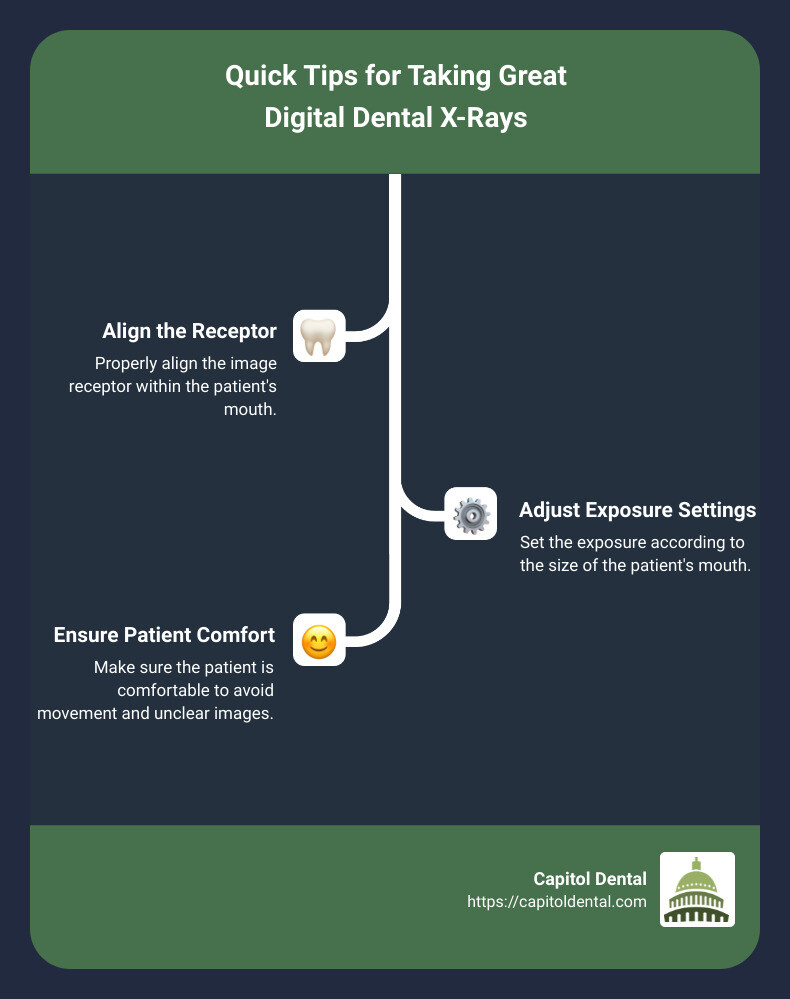
Quick Tips for Taking Great Digital Dental X-Rays
- Properly align the receptor within the patient’s mouth.
- Adjust the exposure settings according to the patient’s mouth size.
- Ensure the patient is comfortable to avoid movement and unclear images.
- Position the X-ray head correctly to avoid distorted images.
At Capitol Dental, we prioritize using advanced digital dental X-rays to provide detailed, high-resolution images with minimal radiation exposure. These modern techniques help improve diagnostic accuracy, which ultimately benefits your dental health.
By mastering these practices, you can ensure more effective and comfortable dental visits, leading to a healthier and brighter smile.
Understanding Digital Dental X-Rays
Types of Digital Dental X-Rays
Digital dental X-rays are a game-changer in modern dentistry. They offer clearer images with less radiation than traditional X-rays. Let’s break down the types of digital dental X-rays, so you know what to expect at your next visit to Capitol Dental.
Intraoral Radiographs
Intraoral X-rays are taken inside your mouth. These are the most common types and provide detailed images of your teeth and gums.
- Bitewing X-rays: These show the upper and lower teeth in one area of the mouth. They help to detect decay between teeth and check bone density.
- Periapical X-rays: These X-rays give a detailed view of the entire tooth, from the crown to the root. They’re useful for diagnosing issues like root infections or fractures.
- Occlusal X-rays: These capture a broader view of the bite, showing the entire arch of teeth in the upper or lower jaw. They’re great for spotting issues with tooth development or placement.
Extraoral Radiographs
Extraoral X-rays are taken from outside your mouth. They focus on the jaw and skull rather than individual teeth.
- Panoramic X-rays: These provide a wide view of the entire mouth, jaw, and surrounding structures. They’re useful for assessing the development of teeth, locating impacted teeth, and evaluating the jaw joint.
- Cephalometric X-rays: These focus on capturing the side view of the head. They help dentists plan treatments like braces by analyzing the position of the jaw and teeth.

Both types of digital dental X-rays are conducted under the supervision of a professional dentist. This ensures the images are detailed and informative, aiding in accurate diagnosis and treatment planning.
Digital dental X-rays are not just about taking pictures; they are a critical diagnostic tool. They help in identifying hidden dental issues that might not be visible during a regular dental exam. This technology allows for early detection and treatment, ensuring better dental health.
By understanding the different types of digital dental X-rays, you can be better prepared for your next dental visit and feel more comfortable with the process.
Next, we’ll dive into how to take good digital dental X-rays, ensuring you get the most accurate and clear images possible.
How to Take Good Digital Dental X-Rays
Proper Sensor Positioning
Align the image receptor: Position the sensor parallel to the long axis of the teeth. This ensures that the captured images are clear and accurate.
Avoid bending the film: Using rigid digital receptors can help prevent bending, which can distort the images. Choose a receptor size that fits comfortably in the patient’s mouth.
Move sensor to midline: For certain shots, like the maxillary anterior segment, use a rolling scoop motion to place the sensor. Ensure the cable is out of the way and have the patient bite down on the bite block for stability.
Correct Tubehead Angles
Dissect the angle technique: Focus on the teeth and the sensor, not just the ring of your X-ray holder. This technique helps in reducing overlapping images.
Align with teeth: Position the tubehead so that the X-ray beam goes through the specific teeth you’re targeting. This alignment ensures that the images are clear and diagnostic.
Avoid cone cuts: Practice positioning the tubehead correctly to avoid partial images. Adjust the tubehead and sensor placement to capture the full area of interest.
Ensuring Patient Comfort
Retract cheeks: Use an instrument or your finger to gently retract the patient’s cheek. This gives you better access and visibility.
Support neck and head: Provide neck and head support to help the patient stay still. Stability reduces the chances of blurry images.
Manage gag reflex: Techniques like asking the patient to hum or breathe deeply through their nose can help. For sensitive areas, place the sensor on top of the tongue and roll it into position.
Adjusting Exposure Settings
Size of patient’s mouth: Larger mouths require more light, while smaller mouths need less. Adjust your exposure settings accordingly.
Correct receptor size: Use a receptor that fits the patient’s mouth. This ensures comfort and reduces the need for retakes.
Proper exposure: Adjust the settings to avoid over or underexposed images. For children or petite adults, use lower settings compared to larger adults.
By following these tips, you can ensure that your digital dental X-rays are of high quality, providing clear and accurate images for better diagnosis and treatment planning.
Common Mistakes and How to Avoid Them
Mistake #1: Distance from X-Ray Head
One common mistake is positioning the x-ray head too far from the patient. Think of the x-ray head like a shotgun: the farther it is, the more spread out the x-rays will be. This leads to light, blurry images.
How to avoid it:
- Position the x-ray head close to the patient’s cheek. Aim to get the x-ray tube as close to the skin as possible. This reduces the spread of x-rays and improves image clarity.
- Consistency is key. Ensure that the cone placement is consistently the same distance from the patient’s cheek for every shot. This helps maintain dependable image contrast.
Mistake #2: Not Looking at Patient’s Teeth
Another frequent error is not aligning the tubehead properly with the patient’s teeth. Each patient’s oral anatomy is different, so the alignment must be adjusted accordingly.
How to avoid it:
- Align the tubehead with the teeth and the sensor. Focus on the patient’s teeth and the film, not just the aiming ring or holder.
- Use the smile technique. Ask the patient to smile to naturally retract their lips, making it easier to see everything. This also helps suppress the gag reflex, making the process more comfortable for the patient.
Mistake #3: Incorrect Angulation
Incorrect angulation can lead to overlapping images or cone cuts. This often happens when the tubehead is not aligned correctly with the sensor, especially in extreme angles.
How to avoid it:
- Dissect the angle technique. Remember the technique you learned in hygiene school. Position the tubehead so the beam goes through the specific teeth you’re focusing on.
- Adjust the patient’s head position. For lower PAs, have the patient tilt their chin up. For maxillary molar PAs, ask them to look straight ahead or tilt their chin down. Proper head and neck positioning help you adjust the tubehead without interference.
By avoiding these common mistakes, you can significantly improve the quality of your digital dental X-rays. Consistency, attention to detail, and patient comfort are key to capturing clear and accurate images.
Advanced Tips for Perfecting Your Technique
Experiment with Sensor Placement
Sensor placement can make or break your X-rays. Don’t be afraid to move the sensor around. One tip is to move the sticky tab lower down. This helps you capture the apex of a molar more easily. It might seem like the film is hanging off the sensor, but it works!
Another trick is to move the sensor toward the middle of the patient’s mouth. This positioning often makes the process more comfortable and gives you more “wiggle room” to parallel the film with the teeth. However, be mindful of any palatal tori that might get in the way.
For molar PAs, adjust the sensor further back or forward as needed. This helps in getting the entire root and the area around the apex. These films often require more exaggerated tubehead angulation.
Use of Modern Technology
Using advanced technology can significantly improve your X-ray results. For instance, a digital panoramic X-ray can rotate around the patient’s head to produce a comprehensive image of the mouth. This is particularly useful for capturing high-quality, high-resolution images.
Modern digital X-rays also provide immediate results. This allows you to quickly assess whether the images are clear or if you need to retake them. Plus, digital X-rays are safer, using less radiation than traditional methods.
Practice and Ask for Help
Practice makes perfect. If you’re struggling with certain shots, give yourself time to practice. For example, if your premolar bitewings or maxillary canine PAs are consistently off, take some time to refine your technique.
Don’t hesitate to ask for help. Whether you’re still in school or working in private practice, seeking guidance shows your commitment to quality care. Ask colleagues who take great X-rays for tips, or get some one-on-one tutoring from an instructor if you’re in school.
Continuous improvement is key. Regularly review your technique and stay open to feedback. This commitment to excellence will make you a better hygienist in the long run.
Frequently Asked Questions about Digital Dental X-Rays
How to take a digital dental X-ray?
- Retract the cheek: Use an instrument or your finger to gently pull the patient’s cheek away. This gives you a clear view and makes it easier to position the sensor.
- Guide the sensor: Use a rolling scoop motion to place the sensor inside the patient’s mouth. Make sure the sensor is parallel to the long axis of the teeth.
- 45º angle: For posterior mandibular X-rays, insert the sensor at a 45º angle between the teeth and tongue. This helps in capturing a clear image without causing discomfort.
- Move the sensor back: Steadily move the sensor back until it’s level with the posterior teeth. Ensure the sensor’s cable is out of the way, then have the patient bite down on the bite block.
What is the number 1 mistake when taking dental X-rays?
The most common mistake is distance from the x-ray head. Clinicians often position the x-ray head too far from the patient, causing the X-rays to spread out and result in light, unclear images.
Tip: Keep the x-ray head close to the patient’s face during exposure. Consistency with placement distance is crucial for dependable image contrast.
How to improve taking dental X-rays?
Patient Comfort: Use foam cushions or gauze to make the process more comfortable. For mandibular anterior X-rays, have the patient place the tip of their tongue to the lingual of their lower jaw incisor teeth.
Align the Image Receptor: Correctly position the receptor and handheld x-ray beam. Misalignment can cause the teeth to appear overlapped, shortened, or elongated.
Correct Receptor Size: Use the appropriate size receptor based on the patient’s mouth size. This ensures the entire area of interest is captured.
Proper Exposure: Avoid underexposure and overexposure by following the sensor’s recommended settings. Underexposed images look too light and grainy, while overexposed images appear too dark.
Include Images of Missing Teeth: When taking full-mouth X-rays, include all sections of the mouth, even areas with missing teeth like where wisdom teeth have been removed. This provides a complete view for diagnosis.
By focusing on these techniques, you can significantly improve the quality of your digital dental X-rays, ensuring better diagnostic outcomes and patient satisfaction.
Conclusion
Using proper technique when taking digital dental X-rays is crucial. It ensures high-quality images, which help us diagnose and treat dental issues effectively. Proper sensor positioning and correct tubehead angles are essential steps. These practices prevent distorted images and missed diagnoses. Ensuring patient comfort and adjusting exposure settings also play a significant role.
Digital dental X-rays offer numerous benefits. They provide high-resolution images quickly and with less radiation. This technology allows us to detect problems early, plan treatments accurately, and monitor progress over time.
At Capitol Dental, we prioritize using advanced technology to deliver the best care. Our use of digital X-rays ensures that every patient receives a thorough and precise evaluation. We are committed to your oral health and aim to make your visit as comfortable and efficient as possible.
Ready to experience the benefits of digital dental X-rays? Contact Capitol Dental today and schedule your appointment. Let’s work together for a healthier, brighter smile.