



Steps of Dental Crown with 3D Printer: Top 6 Best Methods
Introduction
The evolution of 3D printing technology has revolutionized the dental industry by significantly enhancing both efficiency and accuracy in dental crown production. If you’re searching for the steps of dental crown with 3D printer, here is a quick overview:
- Digital scanning
- CAD design
- Preparing the 3D printer
- Printing the crown
- Post-processing
- Quality assurance and fitting
Using 3D printers in dentistry not only speeds up the process but also delivers highly customized and precise dental crowns. Before diving into the detailed steps, it’s worth noting how 3D printing minimizes the traditional lab work, simplifies the workflow, and boosts patient satisfaction.
Indeed, 3D printing for dental applications like crowns, night guards, and surgical guides ensures better patient outcomes. The technology allows dental practices to create accurate replicas of patients’ teeth, reducing both time and costs involved.
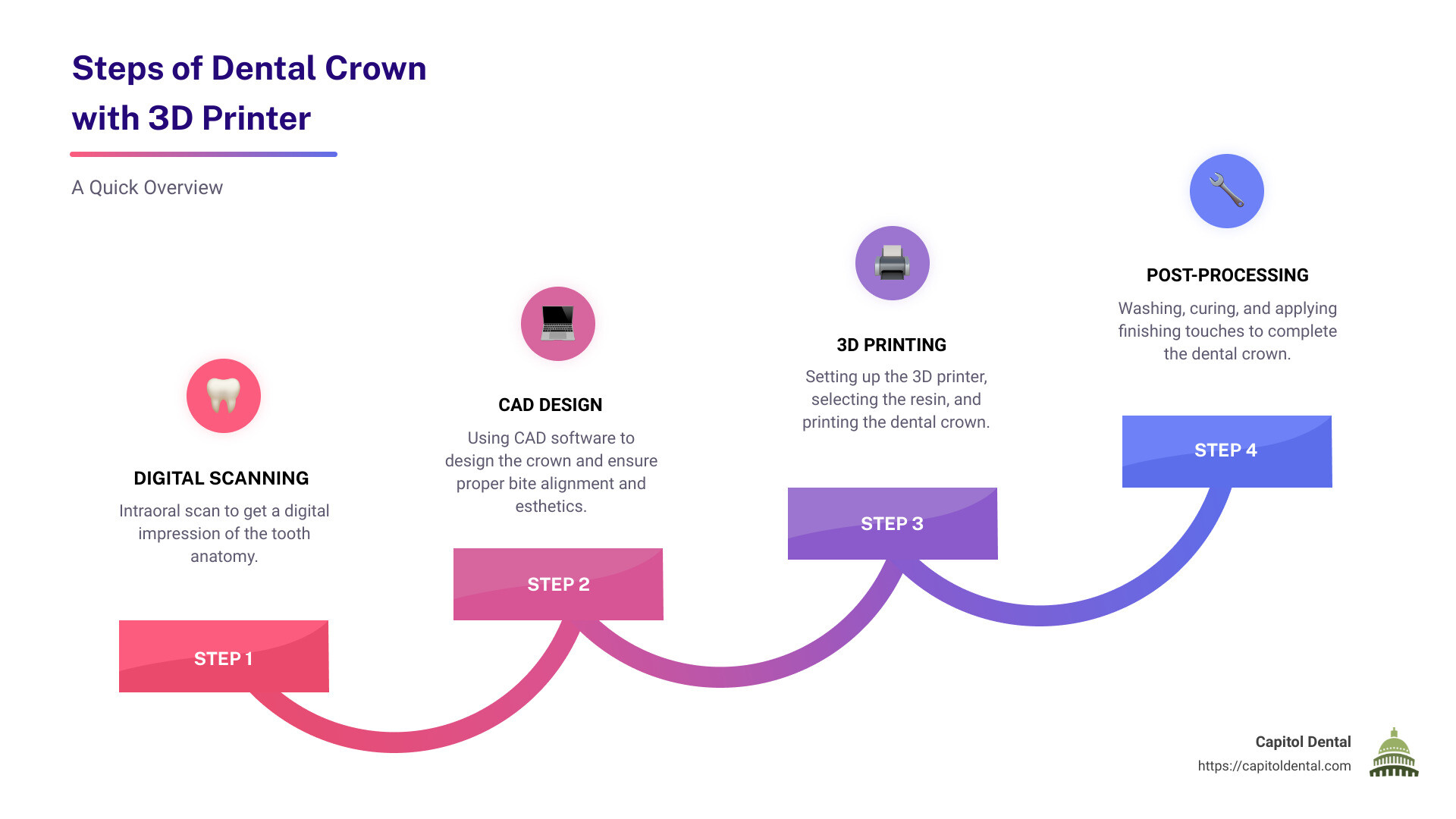
Here’s a simple infographic to give you a quick rundown of the steps of dental crown with 3D printer:
Understanding the Basics of 3D Printing for Dental Crowns
3D printing has revolutionized the dental industry by making the process of creating dental crowns faster, more accurate, and cost-effective. Let’s break down the basics of this technology and how it applies to dental crowns.
The Role of Intraoral Scanners
Intraoral scanners are the starting point for creating a 3D-printed dental crown. These devices, such as the Medit Scan, capture high-resolution, digital images of a patient’s teeth and mouth.
These digital impressions are far more accurate than traditional molds. They allow dentists to see a precise 3D model of the tooth anatomy, which is crucial for designing a well-fitting crown.

Selecting the Right CAD Software
Once the digital scan is complete, the next step involves using CAD (Computer-Aided Design) software. Programs like exocad are commonly used for this purpose.
The software helps in designing the crown by considering various factors:
– Digital Design: The software creates a digital model of the crown, ensuring it fits perfectly with the patient’s bite and natural tooth morphology.
– Crown Morphology: Detailed customization of the crown’s shape, size, and surface texture.
– STL Files: The final design is exported as an STL (Stereolithography) file, which is the standard file format for 3D printing.
Importance of Choosing Quality Resin
The material used in 3D printing dental crowns is just as important as the technology itself. Quality resins, such as SprintRay OnX NanoCeramic, are essential for creating durable and biocompatible dental products.
- Biocompatibility: Ensures that the material is safe and non-reactive within the human body.
- Durability: High-quality resins are strong enough to withstand the daily wear and tear of chewing and biting.

By understanding these basics, dental practices can better utilize 3D printing technology to enhance patient care and streamline their workflows.
Next, we will delve into the steps of dental crown with 3D printer to provide a detailed look at the entire process.
Steps of Dental Crown with 3D Printer
Step 1: Digital Scanning
The journey starts with digital scanning. Using an intraoral scanner, the dentist captures a digital impression of the patient’s tooth anatomy. This high-resolution scan provides a precise 3D model of the area needing a crown. The process is quick and eliminates the need for traditional messy molds.

Step 2: Designing the Crown
Next, the digital impression is imported into CAD software. Here, the dentist or dental technician performs CAD modeling to design the crown. They ensure proper bite alignment and esthetics, creating a digital model that mimics the natural tooth. Once satisfied, the design is exported as an STL file, ready for printing.
Step 3: Preparing the 3D Printer
With the STL file in hand, it’s time to prepare the 3D printer. At Capitol Dental, we use the SprintRay Pro 55S. The printer is loaded with a high-quality, biocompatible resin. Setup parameters, such as layer thickness and print speed, are configured in the SprintRay software to ensure accuracy.

Step 4: The Printing Process
The 3D printing begins with layer slicing. The SprintRay software slices the digital model into thin layers, guiding the printer to build the crown layer by layer. The printer’s settings are optimized for precision, ensuring the final product is both accurate and durable.
Step 5: Post-Processing Techniques
Once printed, the crown undergoes post-processing. This includes washing to remove any uncured resin, followed by curing in the SprintRay Pro Cure 2. The curing process hardens the crown, making it ready for the final touches. Any minor adjustments or polishing are done to ensure a perfect fit.
Step 6: Quality Assurance and Fitting
The final step is quality assurance and fitting. The dentist performs a test fitting to ensure the crown fits perfectly. Any necessary bonding protocols are followed to secure the crown in place. Final adjustments are made to ensure the crown aligns with the patient’s bite and looks natural.
By following these steps, Capitol Dental ensures that each 3D-printed crown is precise, durable, and ready to enhance the patient’s smile.
Next, we will discuss the advantages of 3D printed dental crowns over traditional methods, highlighting why this technology is a game-changer in dentistry.
Advantages of 3D Printed Dental Crowns Over Traditional Methods
3D printing has revolutionized dental crown production. Let’s explore why it’s superior to traditional methods.
Speed
One of the biggest benefits is speed. Traditional methods require multiple visits and weeks of waiting. With 3D printing, you can complete the process in a single day.
Mike Jafar, CEO of Desktop Health, highlights this advantage: “With our technology, patients can go home the same day with their permanent prosthetic.”
Cost-Effectiveness
3D printing is cost-effective. Traditional crowns involve high lab fees and multiple appointments. 3D printing cuts out the middleman, reducing costs significantly.
Shao, a dentist who uses 3D printers, said he made back his investment on the very first complex case.
Patient Satisfaction
Patients love the quick turnaround and precision. Shao noted that 3D-printed mockups helped convince patients to proceed with treatments, providing a competitive edge.
Customization
3D printing allows for unparalleled customization. Each crown is tailored to fit the patient’s unique dental anatomy, ensuring a perfect fit and natural look.
Comparing CNC Milling and 3D Printing
Material Costs
– CNC Milling: Higher material waste and costs.
– 3D Printing: Uses only the necessary amount of resin, reducing waste and costs.
Labor Steps
– CNC Milling: Requires multiple labor-intensive steps.
– 3D Printing: Streamlined process with fewer labor steps.
Production Speed
– CNC Milling: Slower, requiring more time for each crown.
– 3D Printing: Faster, producing crowns in a fraction of the time.
Impact on Dental Practices
In-House Production
3D printing allows for in-house production, eliminating the need to send impressions to an external lab. This reduces turnaround times and costs.
Reduced Turnaround Times
With 3D printing, crowns can be produced and fitted in a single visit, enhancing patient convenience and satisfaction.
Enhanced Patient Experience
Patients appreciate the quick, precise, and comfortable process. Seeing a digital mockup of their crown helps them feel confident in the treatment plan.
Tim Schmitt, vice president of sales and marketing for Dental Product Shopper, believes that 3D printing has the potential to be a disruptive technology in dentistry. “The big game-changer moment will come when it becomes standard practice to 3D-print crowns and implants right in the dentist’s office,” he said.
In summary, 3D printing offers numerous advantages over traditional methods, making it a valuable addition to modern dental practices.
Next, we will delve into frequently asked questions about 3D printed dental crowns to clarify any lingering doubts and provide more insights.
Frequently Asked Questions about 3D Printed Dental Crowns
How long does it take to 3D print a crown?
With 3D printing technology, the process of creating a dental crown is significantly faster compared to traditional methods. According to SprintRay Inc., a finished dental product can be printed within an hour right at the dentist’s office. This rapid turnaround is a major advantage, allowing patients to receive their permanent crowns in a single visit.
Can you make a crown with a 3D printer?
Yes, you can make a crown with a 3D printer. Companies like Desktop Health and SprintRay have developed advanced 3D printers and biocompatible resins specifically for dental applications. For instance, Desktop Health’s Einstein 3D printer, along with their FDA-cleared Flexcera Smile Ultra+ resin, enables dentists to print crowns, bridges, veneers, and more onsite.
What is the procedure for 3D printing?
The procedure for 3D printing a dental crown involves several key steps:
- Digital Scanning: The process begins with an intraoral scan of the patient’s mouth, capturing a high-resolution digital impression of the tooth anatomy.
- Designing the Crown: Using CAD software, the dentist designs the crown, ensuring proper bite alignment and esthetics. The design is then exported as an STL file.
- Preparing the 3D Printer: The 3D printer is set up with the appropriate resin and parameters. For example, SprintRay Pro 55S is a popular choice among dental practices.
- The Printing Process: The STL file is sliced into layers, and the printer begins building the crown layer by layer. This process can take about an hour.
- Post-Processing Techniques: After printing, the crown undergoes washing and curing to harden the resin. Final touches are added to ensure a smooth finish.
- Quality Assurance and Fitting: The dentist test-fits the crown, making any necessary adjustments before bonding it permanently to the patient’s tooth.
By following these steps, dentists can efficiently produce high-quality dental crowns onsite, enhancing patient satisfaction and reducing the overall treatment time.
Conclusion
At Capitol Dental in Boise, Idaho, we are committed to leveraging advanced dental technologies to provide comprehensive dental services. Our use of 3D printing technology allows us to create high-quality dental crowns efficiently and accurately, ensuring that our patients receive the best possible care.
Advanced Dental Technology
We utilize state-of-the-art tools such as digital x-rays, intraoral scanners, and 3D printers to enhance our dental services. These technologies not only improve the precision of our treatments but also significantly reduce the time required for procedures. For example, with our in-house 3D printing capabilities, we can produce customized dental crowns in a single visit, eliminating the need for temporary crowns and multiple appointments.
Comprehensive Dental Services
Our range of services includes everything from crowns and implants to smile makeovers and clear aligners. Each treatment plan is tailored to meet the specific needs of our patients, ensuring both aesthetic and functional excellence. Whether you’re looking to restore a damaged tooth, replace missing teeth, or enhance your overall smile, our team is here to help.
By integrating cutting-edge technology with personalized care, Capitol Dental is at the forefront of modern dentistry. We invite you to experience the benefits of our advanced dental solutions. To learn more about our services, visit our Boise Cosmetic Dentistry page.
At Capitol Dental, we’re not just improving smiles; we’re revolutionizing the way dental care is delivered. Join us in embracing the future of dentistry today.