



Teeth Printing: Top 3 Reasons to Smile in 2024!
Introduction
Teeth printing is revolutionizing dental care by using 3D printing technology to create custom, durable dental solutions. If you’re looking for a quick answer on teeth printing, here’s what you need to know:
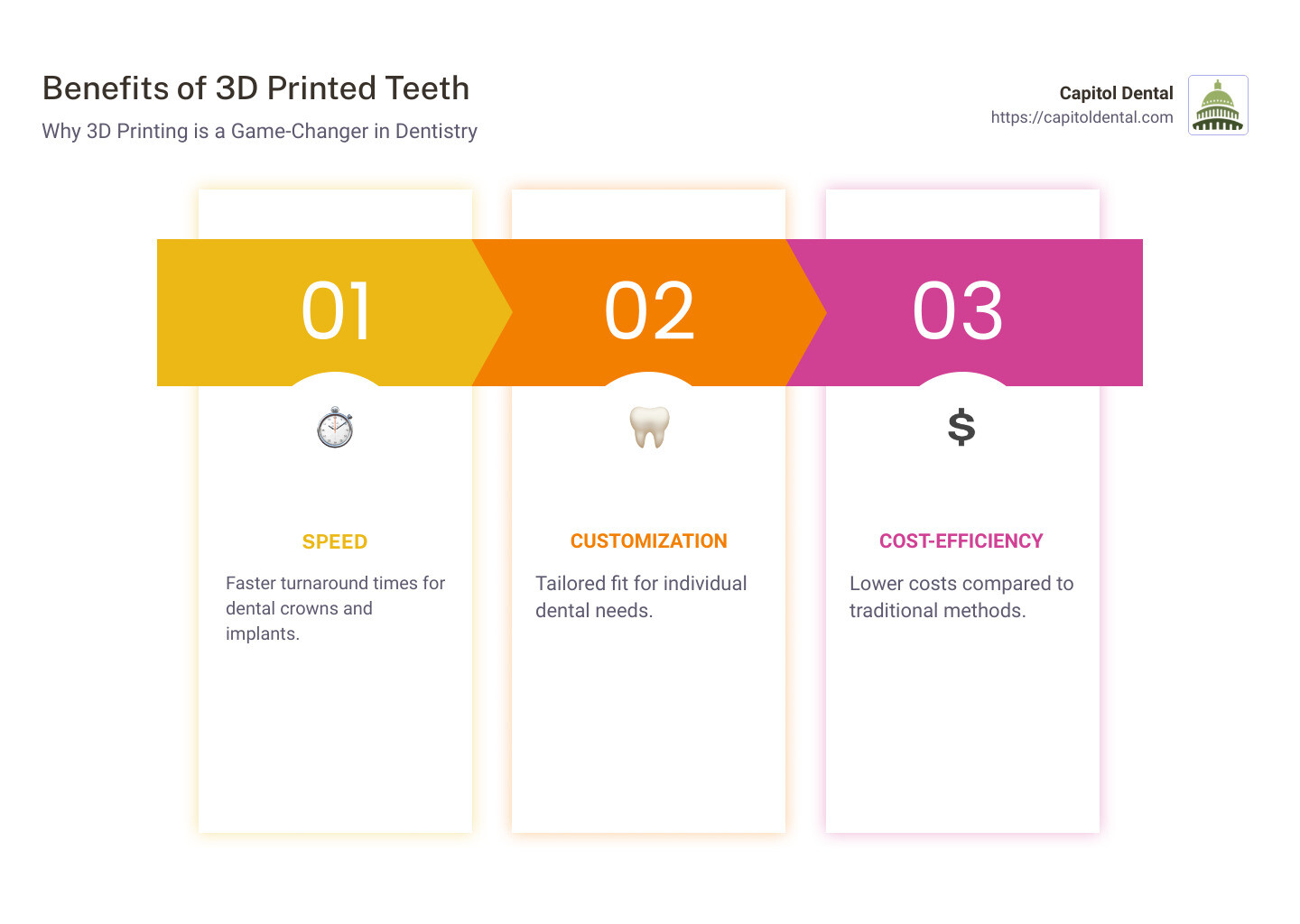
- Speed: Faster turnaround times for dental crowns and implants.
- Customization: Tailored fit for individual dental needs.
- Cost-efficiency: Lower costs compared to traditional methods.
Imagine getting a new dental crown made precisely for your mouth while you wait. This is the magic of 3D printing in dentistry. Utilizing digital innovation, dentists can now create high-quality and personalized dental pieces, such as crowns, bridges, and even dentures, with exceptional accuracy and speed.
3D printing works by building objects layer by layer from digital models, allowing for high customization and perfect fits. From improving smiles to enhancing oral health, this technology is transforming dental practices worldwide. Patients benefit from quicker procedures, fewer adjustments, and overall better results.
Here’s a snapshot of what makes 3D printed teeth a game-changer:
What is Dental Printing?
Dental printing leverages 3D technology to create highly customized dental solutions. This process starts with a digital scan of your mouth, which is then used to design precise models of teeth, veneers, or other dental appliances. The digital model is sent to a 3D printer, which builds the object layer by layer, ensuring a perfect fit.
Custom Veneers
3D printing allows for the creation of custom veneers that fit perfectly over your natural teeth. Traditional veneers often require multiple visits and adjustments, but 3D printing speeds up this process. With an intraoral scanner, dentists can capture accurate impressions of your teeth, reducing the need for messy molds.
Aesthetic Transformations
One of the most exciting aspects of 3D printing in dentistry is its potential for aesthetic transformations. Whether you need a single tooth replacement or a full set of dentures, 3D printing can produce natural-looking results that blend seamlessly with your existing teeth. The precision of this technology ensures that your new teeth not only look good but also function well.

Patients have reported high satisfaction with 3D printed dental solutions. For example, a patient said, “Doctor, you have no idea how much this means to me… I cannot thank you enough, this is amazing how far we have come where you can 3D print a permanent tooth.” This highlights the profound emotional and practical impacts of this technology, making dental care more accessible and effective.
Next, we will dive into the durability and longevity of 3D printed dental solutions.
The Durability and Longevity of 3D Printed Dental Solutions
How Long Do 3D Printed Teeth Last?
3D printed teeth can be incredibly durable, often lasting as long as traditional dental solutions. With proper care, 3D printed crowns and dentures can last between 10 to 15 years. This longevity is comparable to traditional methods, such as ceramic crowns, which are known for their durability and natural appearance.
Proper Care Tips:
– Brush your teeth twice daily with a soft-bristle toothbrush.
– Floss daily to remove plaque and food particles.
– Avoid hard foods like ice and hard candies that can crack the crown.
– Visit your dentist regularly for check-ups and cleanings.
By following these simple care habits, you can ensure your 3D printed dental solutions remain strong and look great for many years.
How Much Do 3D Printed Dentures Cost?
The cost of 3D printed dentures can vary based on several factors, including the materials used and the complexity of the design. Generally, 3D printed dentures are more cost-effective compared to traditional dentures.
Key Factors Influencing Costs:
- Laboratory Costs: 3D printing reduces the need for extensive laboratory work, which can lower overall costs.
- Milled Dentures vs. Traditional Dentures: Traditional dentures require more manual labor and time, making them more expensive. Milled dentures, although durable, also involve higher costs due to the milling process.
In contrast, 3D printing allows for quicker production times and less manual intervention, making it a more affordable option for many patients.
By investing in 3D printing technology, dental practices can significantly reduce costs and improve efficiency, ultimately passing these savings on to patients. This makes high-quality dental care more accessible and affordable for everyone.
Next, we will explore the process of creating 3D printed teeth and the advanced materials used in these innovative dental solutions.
The Process of Creating 3D Printed Teeth
Can You 3D Print New Teeth?
Yes, you can 3D print new teeth! This technology is transforming dental care, making it easier and faster to get dental implants, crowns, and replacement teeth.
Dental Implants: Dental implants are posts surgically inserted into the jawbone to support replacement teeth. Using 3D printing, these implants can be customized to match the complex structure of your jawbone. This ensures a perfect fit and better integration with your natural bone.
Crowns: 3D printed crowns are a game-changer. Traditional crowns can take days or weeks to produce, but with 3D printing, this timeline is reduced to hours. This not only speeds up the process but also ensures high precision and a better fit. According to Capitol Dental, the use of intraoral scanners and digital impressions allows for highly accurate and customized crowns.
Replacement Teeth: If you need a replacement tooth, 3D printing can create a digital model of your tooth, which is then printed into a physical replacement. This method is quick, precise, and ensures that the new tooth fits perfectly with your existing teeth.
Advanced Materials Used in 3D Printed Teeth
The materials used in 3D printing for dental applications are just as important as the technology itself. Here are some of the advanced materials commonly used:
Hydroxyapatite: This material is often used in 3D printed dental implants and bone grafts. Hydroxyapatite is biocompatible and mimics the mineral component of bone, making it ideal for dental applications. Studies have shown that hydroxyapatite-polylactic acid composites increase the mechanical properties of implants without compromising their performance.
Porcelain: Porcelain is a popular material for dental crowns and veneers due to its natural appearance and durability. 3D printing with porcelain allows for the creation of highly detailed and aesthetically pleasing dental restorations.
Methacrylate-based Photopolymer: This resin is used in 3D printing to create temporary crowns and other dental appliances. Advances in resin technology have led to stronger and more reliable temporary crowns, which are essential for patients awaiting permanent solutions.
By using these advanced materials, 3D printing can produce dental solutions that are not only functional but also aesthetically pleasing and durable.
Next, we will explore the various applications and benefits of 3D printed teeth in modern dentistry.
Applications and Benefits of 3D Printed Teeth in Modern Dentistry
3D Dental Implants
3D dental implants are revolutionizing the way we think about tooth replacement. Unlike traditional methods, which can be time-consuming and less precise, 3D printed implants offer a more accurate and efficient solution. These implants can be designed to mimic the bone-like structure of the jaw, providing a strong and stable foundation for crowns and dentures.
A key advantage is the ability to replicate the complex anatomy of the jawbone. This ensures that the implant fits perfectly, reducing the risk of complications and improving overall success rates. According to research, 3D printing technology allows for high precision in creating implants with intricate details, enhancing their integration with natural bone.
3D Dentures
Gone are the days of multiple dentist visits just to get a set of dentures. With 3D printed dentures, the process is much quicker and more efficient. Using an intraoral scanner, dentists can capture a detailed digital impression of your mouth in a matter of minutes. This eliminates the need for messy and uncomfortable traditional impressions.
The digital impression is then used to design dentures that fit perfectly and look natural. The Journal of 3D Printing in Medicine highlights that this technology not only reduces the number of visits but also ensures a more accurate fit, giving you a natural-looking smile with less hassle.
3D Aligners
3D printed aligners offer a modern solution for correcting malocclusions and achieving a straight smile. These orthodontic appliances are custom-designed to fit your teeth perfectly, gently moving them into the desired position over time.
The process starts with an intraoral scan to create a digital model of your teeth. This model helps orthodontists determine the best course of treatment. According to the Journal of Stomatology, intraoral scans provide higher accuracy and reliable diagnosis, making the treatment process shorter and more comfortable.
With 3D technology, you can achieve a straight smile more efficiently and comfortably than ever before. This innovative approach ensures that each aligner is tailored to your unique dental structure, providing optimal results with fewer adjustments.
By leveraging the power of 3D printing, modern dentistry is transforming how we approach dental care. Whether it’s implants, dentures, or aligners, teeth printing offers a faster, more precise, and more comfortable experience for patients.
Frequently Asked Questions about Teeth Printing
What Are the Costs Associated with 3D Printed Teeth?
Average costs: The cost of 3D printed teeth can vary depending on the specific treatment and materials used. Generally, 3D printed crowns might cost between $300 to $600 per tooth. For dentures, the price range could be $1,000 to $3,000.
Comparison with traditional methods: Traditional dental crowns and dentures often require multiple visits and temporary solutions, which can increase the overall cost. 3D printing reduces the need for these extra steps, making the process more cost-effective. For example, traditional crowns can cost up to $1,500 per tooth, making 3D printed options a more affordable choice.
What Materials Are Used for 3D Printing Teeth?
Composite materials: 3D printed teeth are made from various advanced materials like resins, ceramics, and composites. These materials are chosen for their durability, aesthetics, and compatibility with the human body.
Biocompatibility: It’s crucial that the materials used are safe and non-reactive within the mouth. High-quality resins and ceramics ensure that the printed teeth are biocompatible and do not cause any adverse reactions.
Aesthetics: Materials like ceramics closely mimic the appearance and translucency of natural teeth, providing a natural look that blends seamlessly with the rest of your smile. Composite materials can be tailored to match the color and texture of your natural teeth, ensuring a perfect fit.
How Does 3D Printing Technology Change Dental Treatments?
Speed: One of the biggest advantages of 3D printing in dentistry is the speed of production. Traditional dental procedures can take weeks, but with 3D printing, you can get your dental crowns, dentures, or aligners in just a few days or even hours.
Customization: 3D printing allows for highly customized dental solutions. Each dental piece is designed to fit the patient’s unique dental structure, ensuring a perfect fit and optimal comfort. This level of customization is difficult to achieve with traditional methods.
Predictability: The precision of 3D printing technology ensures that the final product matches the digital design exactly. This predictability reduces the need for adjustments and improves the overall success rate of dental treatments.
By leveraging the power of 3D printing, modern dentistry is transforming how we approach dental care. Whether it’s implants, dentures, or aligners, teeth printing offers a faster, more precise, and more comfortable experience for patients.
Conclusion
At Capitol Dental, we are proud to embrace the latest advancements in dental technology to provide our patients with the best possible care. Our commitment to personalized care means we tailor every treatment to meet your unique needs, ensuring you achieve the perfect smile you deserve.
Advanced technology like 3D printing allows us to offer a range of innovative dental solutions, from custom veneers to precise dental implants. This cutting-edge approach not only speeds up the treatment process but also enhances the accuracy and comfort of dental procedures.
By integrating 3D printing into our practice, we can create highly customized dental appliances that fit perfectly and look natural. Whether you need a full set of dentures or a single crown, our use of teeth printing technology ensures that you receive the most advanced and effective treatment available.
Ready to experience the future of dental care? Contact Capitol Dental today to schedule your free initial appointment and discover how 3D printed dental solutions can transform your smile. Your journey to a perfect smile starts with us!