



3D Printed Dental Crown Cost: 5 Key Benefits in 2024
Introduction
When it comes to 3D printed dental crown cost, understanding the financial investment can help you make informed decisions about your dental care. Here’s a quick overview of what you need to know:
- Average Cost: Around $500 to $1,500 per crown
- Factors Influencing Cost: Material, printer type, and lab fees
- Savings: Potentially lower than traditional ceramic crowns
3D printing is revolutionizing the dental industry, offering quicker turnaround times and more personalized treatment options. This cutting-edge technology is not just faster but can also be more cost-efficient compared to traditional methods.
Imagine walking out of your dentist’s office with a perfectly fitting crown, crafted in just a few hours. This is the reality of 3D printing in dentistry today. As patients demand more efficient and effective treatments, the evolution of 3D printed dental crowns has become increasingly significant.
One patient exclaimed, “Doctor, you have no idea how much this means to me… I cannot thank you enough, this is amazing how far we have come where you can 3D print a permanent tooth.” This kind of response illustrates the profound emotional and practical impact of 3D printing technology.
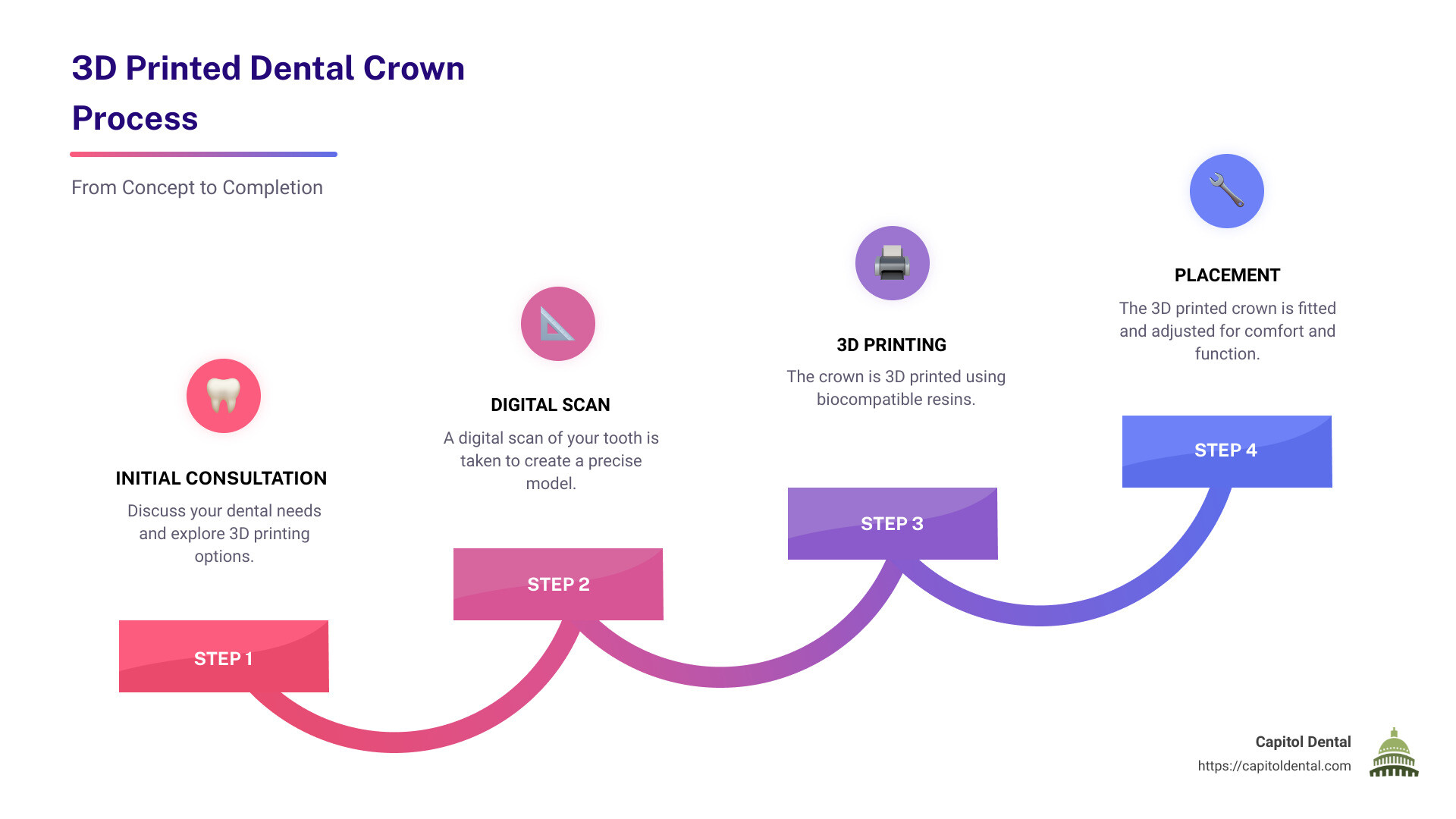
At Capitol Dental, we embrace these advancements to provide you with top-notch, personalized dental care. Here’s how 3D printing is changing the game in dental crown production.
Understanding 3D Printed Dental Crown Costs
3D printing dental crowns is revolutionizing dental care, but understanding the costs involved can help you make an informed decision. Let’s break down the factors influencing these costs and compare them to traditional crowns.
Factors Influencing the Cost
Material Costs
The materials used in 3D printing dental crowns vary, with resins being the most common. For instance, SprintRay Crown by BEGO® is a ceramic-filled hybrid that costs as little as $2 per crown in material. This affordability makes 3D printed crowns highly cost-effective compared to traditional materials like ceramics or metals.
Labor
Labor costs are significantly lower with 3D printing. Traditional crowns require multiple visits and extensive manual work. In contrast, a 3D printed crown can be produced and fitted in a single visit, reducing the need for labor-intensive procedures.
Equipment
Investing in a 3D printer can be a substantial upfront cost. For example, the SprintRay Pro and Form 4B printers range from $8,999 to $34,999. However, these costs are quickly offset by the savings in labor and materials.
Overhead
Overhead costs include the maintenance of the 3D printer and the purchase of resins. However, the efficiency and speed of 3D printing reduce overall overhead compared to traditional methods.
Resin Price
The price of resin is a crucial factor. High-quality resins like VarseoSmile Crown Plus offer superior mechanical properties and aesthetics. While the initial cost may be higher, the longevity and quality of the crowns justify the investment.
Printer Type
Different printers come with varying capabilities and costs. High-end models like the SprintRay Pro offer faster production times and greater accuracy, which can be more cost-effective in high-volume practices.
Technician Time
Technician time is drastically reduced with 3D printing. Traditional crowns require meticulous crafting, whereas 3D printed crowns can be designed and printed with minimal manual intervention.
Comparison with Traditional Crowns
Cost Efficiency
3D printed crowns are generally more cost-efficient. Traditional crowns can cost anywhere from $500 to $1,500 per crown, while 3D printed crowns can be produced for as little as $2 in materials. Over time, the savings add up, especially for practices with high patient volumes.
Time Savings
One of the most significant advantages of 3D printing is the time saved. Traditional crowns often require multiple visits and temporary crowns. In contrast, a 3D printed crown can be produced and fitted in a single visit, often in less than an hour.

Material Differences
Traditional crowns are typically made from ceramics or metals, which are durable but expensive. 3D printed crowns use advanced resins that offer a balance of strength, aesthetics, and cost-effectiveness. For example, Flexcera Smile Ultra+ resin is up to three times more fracture-resistant than some traditional materials.
By understanding these costs and comparing them to traditional methods, it’s clear that 3D printing offers numerous advantages. Next, we’ll explore the benefits of 3D printed dental crowns, from speed and customization to reduced patient discomfort.
Benefits of 3D Printed Dental Crowns
Technological Advancements
3D printing technology has revolutionized the way dental crowns are made. Traditional crowns can take days or even weeks to produce, but with 3D printing, the process is reduced to mere hours. This speed enhances patient satisfaction and allows dental practices to operate more efficiently.
Customization is another standout feature. Using intraoral scans, dentists can create highly precise and personalized dental crowns. This ensures a perfect fit and natural appearance, which reduces the need for adjustments. For instance, SprintRay’s Cloud Design platform allows for the seamless design and production of crowns in-office.
Reduced patient discomfort is a significant benefit. Traditional methods often require multiple visits and uncomfortable molds. With 3D printing, patients can receive their crowns in a single visit, eliminating the need for temporary crowns and multiple fittings.
Material Innovations
Material innovations have played a crucial role in the success of 3D printed dental crowns. Early 3D printed crowns were made from composite resins, which lacked the durability of traditional materials like zirconia. However, advancements in resin technology have led to the development of stronger, more reliable materials.
For example, Flexcera Smile Ultra+ resin, used by Desktop Health’s Einstein 3D printer, allows dentists to print crowns, bridges, and veneers onsite while the patient waits. This resin is up to three times more fracture-resistant than some traditional materials, making it a viable option for permanent crowns.
Biocompatible resins like SprintRay Crown by BEGO® are also gaining popularity. These resins are FDA 510(k) cleared and fulfill all the requirements for a Class II medical device. They offer high strength, resistance to wear, and excellent aesthetics, making them a go-to material for restorative 3D printing.
Real-World Examples
SprintRay has introduced VarseoSmile Crown Plus, which exhibits superior mechanical properties compared to traditional composite materials. This material offers an excellent balance of opacity and transparency, making it ideal for definitive 3D printed restorations.
Formlabs has also made significant strides with their Form 3B printer, specifically designed for dental applications. This printer uses Stereolithography (SLA) to produce crowns, bridges, and other dental appliances with high precision.
In a real-world case, a patient at Capitol Dental was moved to tears upon receiving a 3D printed crown, exclaiming, “Doctor, you have no idea how much this means to me… I cannot thank you enough, this is amazing how far we have come where you can 3D print a permanent tooth.”
These advancements in technology and materials are making 3D printed dental crowns a practical and efficient solution for both dentists and patients.
Next, we’ll delve into the challenges and limitations of 3D printed dental crowns, including durability concerns and aesthetic limitations.
Challenges and Limitations
Longevity of 3D Printed Crowns
Durability Concerns
While 3D printed dental crowns offer many benefits, they are not yet as durable as traditional options. Dr. Austin Vetter noted that FDA-approved materials for 3D printed crowns show noticeable wear over time. These materials struggle to withstand the significant forces exerted by back teeth, leading to faster wear and tear.
Temporary Use
Due to these durability issues, 3D printed crowns are often recommended for temporary use. They serve as cost-effective placeholders while patients wait for more robust solutions like zirconia or metal crowns. Traditional crowns typically last over five years, whereas current 3D printed materials may need replacement much sooner.
Comparison with Zirconia and Metal
Zirconia and eMax crowns are known for their strength and longevity. Studies show that these materials can last more than five years, making them a reliable choice for permanent restorations. In contrast, 3D printed crowns are still catching up in terms of durability. Innovations in ceramic-filled printable materials and ceramic-dominant resins may bridge this gap in the future.
Aesthetic Considerations
Color Matching
One major aesthetic limitation of 3D printed crowns is color matching. Currently, 3D printers can only produce crowns in a single shade at a time. This results in crowns that look more monochromatic and lack the natural translucency and color variations found in real teeth.
Surface Finish
The surface finish of 3D printed crowns can also be less refined compared to traditional crowns. While the precision of 3D printing technology allows for a high level of customization, the final product may still lack the smoothness and polish of milled crowns.
Personalization Limits
Despite the high level of personalization and precision offered by 3D printed crowns, there are still limits. Traditional methods can achieve a more natural-looking finish and better color matching, making them preferable for visible teeth.
Next, let’s explore real-world applications and cost-effectiveness of 3D printed dental crowns, including case studies and patient testimonials.
3D Printed Dental Crown Cost: Real-World Applications
Cost-Effectiveness for Dental Practices
Real-World Applications
Dr. Shao, an early adopter of 3D printing, shared how the technology has revolutionized his practice. By producing precise surgical guides and mockups, he not only saved time but also convinced patients to proceed with complex treatments. One patient even exclaimed, “Doctor, you have no idea how much this means to me… I cannot thank you enough, this is amazing how far we have come where you can 3D print a permanent tooth.”
Cost Breakdown
The cost of a 3D printed dental crown can range from $500 to $1,500, depending on the material and complexity. For instance, SprintRay’s materials cost as little as $2 per crown. Additional costs include ti-bases, scan bodies, equipment, and technician time. However, these costs are often offset by the reduced need for multiple visits and temporary crowns.
ROI and Volume Discounts
Investing in a 3D printer can offer significant ROI for dental practices. The initial investment can be high, but the savings on lab fees, reduced chair time, and increased patient throughput quickly add up. Practices can also benefit from volume discounts on materials and equipment, further lowering the overall cost.
In-House Production vs. Outsourcing
Outsourcing dental crowns to a lab can be costly and time-consuming. In contrast, in-house 3D printing allows for same-day crowns, eliminating the need for temporary solutions and multiple appointments. This not only saves money but also improves patient satisfaction.
Capitol Dental: Pioneering Affordable Dental Solutions in Boise
Comprehensive Services
At Capitol Dental, we have integrated 3D printing technology to offer faster, more cost-effective, and precise dental solutions. Our services include crowns, night guards, surgical guides, and more, all produced right in our clinic.
Advanced Technology
Using state-of-the-art equipment like the SprintRay Pro and Bego, we ensure high accuracy and reliability. Our materials, such as SprintRay Crown by BEGO®, offer excellent aesthetics and durability, meeting all requirements for a Class II medical device.
Personalized Care
Our goal is to make dental care more accessible and efficient for everyone. By embracing new technologies like 3D printing, we provide high-quality, patient-focused care. One patient was so moved by his new 3D printed crown that he wiped away tears, saying, “I cannot thank you enough, this is amazing how far we have come.”
By investing in 3D printing, we not only enhance our services but also make dental care more affordable and convenient for our patients.
Conclusion
Future Outlook
The future of 3D printing in dentistry looks incredibly promising. As materials and technologies advance, we expect 3D printed crowns to become even more durable and aesthetically pleasing. Innovations like ceramic-filled printable materials and AI design software are on the horizon. Eventually, 3D printed crowns might become the standard for both interim and permanent restorations.
Investment Justification
Investing in 3D printing technology offers substantial benefits. For dental practices, it means reduced lab bills, quicker turnaround times, and more efficient workflows. For patients, it translates to lower costs, fewer visits, and a more comfortable experience. According to SprintRay, using 3D printing can save significant costs compared to outsourcing production. Practices that adopt this technology can see a substantial return on investment, making it a wise financial decision.
Capitol Dental’s Role
At Capitol Dental, we are at the forefront of this exciting technology. By integrating 3D printing into our practice, we offer faster, more cost-effective, and precise dental solutions. Our comprehensive services include creating crowns, night guards, surgical guides, and more, right in our clinic. We are committed to making dental care more accessible and efficient for everyone.
Your smile is our priority. Let’s make it the best it can be with the latest in dental technology. Learn more about our cosmetic dentistry services.
By embracing 3D printing, we enhance not only our services but also the overall patient experience. We are excited about the potential of this technology and look forward to incorporating future advancements into our practice.