



3D Printer for Dental Crowns: Top 5 Breakthroughs of 2024
Introduction
3D printers for dental crowns are revolutionizing the way dentists restore and enhance smiles. If you’re curious about the game-changing benefits of 3D printing in dentistry, here’s a quick rundown:
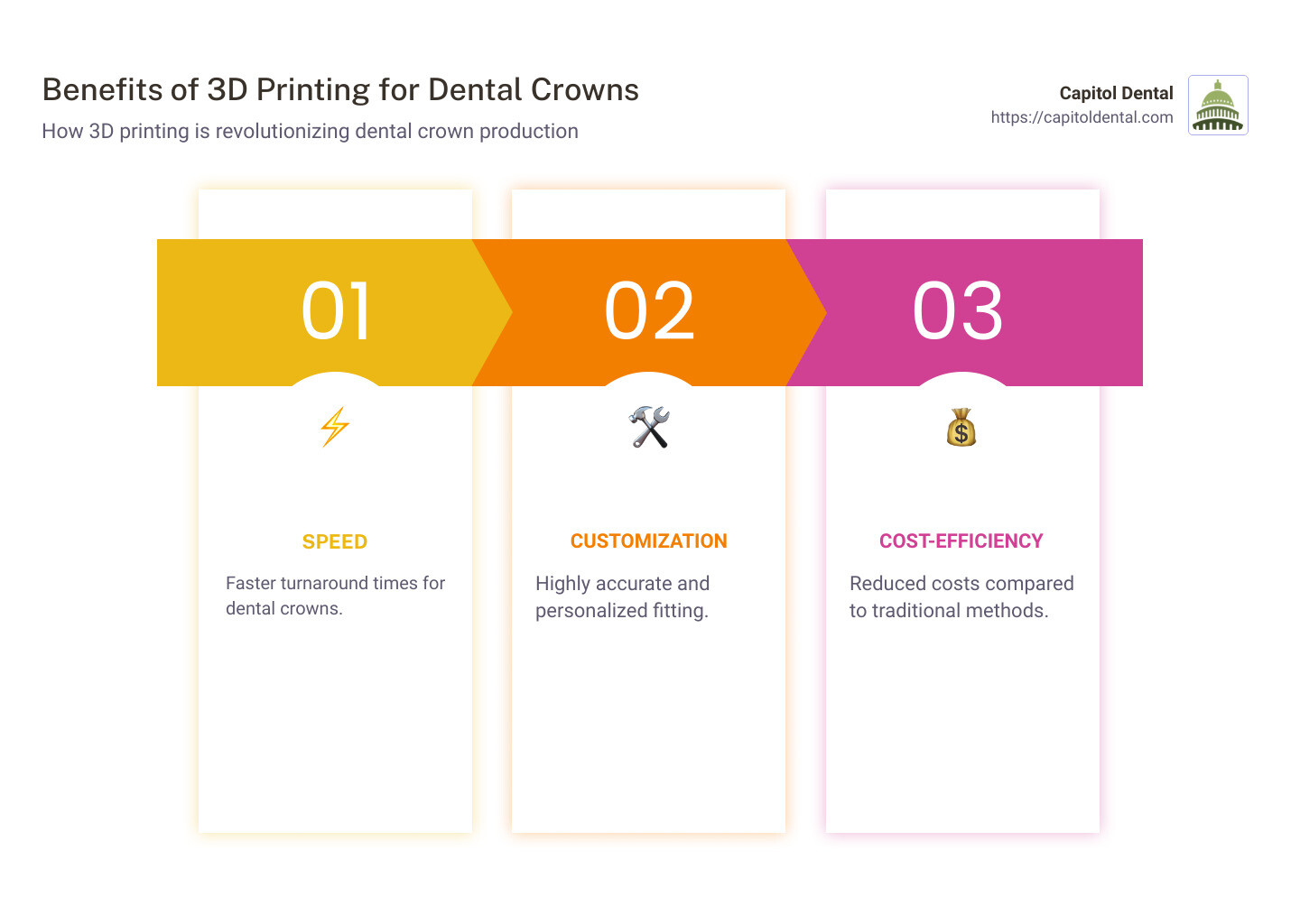
- Speed: Faster turnaround times for dental crowns.
- Customization: Highly accurate and personalized fitting.
- Cost-efficiency: Reduced costs compared to traditional methods.
3D printing has not only sped up the production process but has also provided dentists with the ability to create crowns that are precise, durable, and aesthetically pleasing. The technology integrates advanced digital tools, enabling both dental professionals and patients to experience a seamless, efficient, and comfortable dental restoration process.
Patient testimonials like, “Doctor, you have no idea how much this means to me… I cannot thank you enough, this is amazing how far we have come where you can 3D print a permanent tooth,” highlight the profound emotional and practical impacts of this technology.
At Capitol Dental, our commitment to utilizing cutting-edge technology ensures that you receive the best possible care. Whether it’s for crowns, implants, or smile makeovers, we’re here to provide top-notch solutions that enhance both your smile and your overall oral health.
The Evolution of 3D Printing in Dental Crown Production
3D printing has come a long way since its inception nearly four decades ago. Initially a fringe technology, it has now moved into the mainstream, becoming more affordable and reliable, especially in dentistry.
History of 3D Printing in Dentistry
The journey of 3D printing in dentistry began with the creation of diagnostic models and surgical guides. These early applications didn’t require the strength or durability needed for actual tooth replacements. Instead, they focused on precision, helping dentists plan treatments with greater accuracy.
Over time, technological advancements have allowed 3D printing to expand its role in dentistry. Today, we’re seeing the emergence of 3D printed dental crowns, a leap from mere models to functional, albeit temporary, tooth replacements.
Technological Advancements
The technology behind 3D printing is continually evolving. Here are some key advancements that have shaped its role in dental crown production:
- Material Improvements: Early 3D printed dental crowns were made from composite resins, which lacked the strength and durability of traditional materials like zirconia or eMax. However, advancements in resin technology have led to stronger, more reliable temporary crowns. Although not yet on par with traditional materials, these improvements are significant.
- Precision and Customization: One of the standout features of 3D printing is its ability to produce highly precise and customized dental crowns. The process involves intraoral scanning to create digital impressions, followed by the design and printing of the crown. This level of accuracy ensures a better fit and faster turnaround times.
- Speed and Efficiency: Traditional methods of creating dental crowns can take days or even weeks. With 3D printing, this timeline is reduced to hours. This speed not only enhances patient satisfaction but also allows dental practices to operate more efficiently.
- Stereolithography (SLA): This advanced 3D printing technique uses liquid resin that is hardened into a solid object using UV light. The Form 3B printer by Formlabs, specifically designed for dental applications, utilizes SLA to produce crowns, bridges, and other dental appliances with high precision.

Real-World Impact
The impact of these advancements is palpable. For instance, a patient at Capitol Dental was moved to tears upon receiving a 3D printed crown, exclaiming, “Doctor, you have no idea how much this means to me… I cannot thank you enough, this is amazing how far we have come where you can 3D print a permanent tooth.”
This story underscores the profound emotional and practical benefits of 3D printing in dentistry. While we’re still on the cusp of fully realizing the potential of 3D printers for dental crowns, the progress made so far is promising.
As we look to the future, experts like Dr. Scherer believe we’re just at the tipping point. He predicts, “In five or ten years, we’ll have a 3D printer in dentists’ offices everywhere.” This sentiment is echoed by industry leaders who foresee a time when 3D printing will surpass traditional methods in both efficiency and material flexibility.
Stay tuned as we delve into the key benefits of using 3D printers for dental crowns in the next section.
Key Benefits of Using 3D Printers for Dental Crowns
Cost-Efficiency
One of the biggest advantages of using a 3D printer for dental crowns is cost-efficiency. Traditional methods involve multiple steps and outsourcing to dental labs, which can be expensive. With 3D printing, you can significantly reduce these costs.
Example: Dr. Shao mentioned that investing in a 3D printer allowed him to save money by bypassing external labs. He even recouped his investment on the first complex case! Source
Customization
3D printing offers unparalleled customization. Each crown can be tailored to fit the exact specifications of a patient’s mouth, ensuring a perfect fit.
Quote: “Ceramic crowns are beyond natural looking and can be matched to your own surrounding teeth precisely, to the shade,” says Dr. Ali Saeghi. Source
Fact: The precision of digital impressions and 3D printing ensures a level of accuracy slightly above milled or hand-fabricated prosthetics. Source
Speed
Speed is another critical benefit. Traditional crowns can take weeks to produce, but with 3D printing, this time is reduced to mere hours.
Case Study: SprintRay’s 3D printers have revolutionized dental practices by cutting down production times drastically. This means patients spend less time waiting for their crowns. Source
Statistic: By digitizing each step of the process, days and weeks turn into hours. Source
In summary, the key benefits of using 3D printers for dental crowns include cost-efficiency, customization, and speed. These advantages make 3D printing an increasingly attractive option for both dentists and patients.
Next, we’ll explore the different types of 3D printers suitable for dental crowns.
Types of 3D Printers Suitable for Dental Crowns
When it comes to producing dental crowns, not all 3D printers are created equal. Here are the main types of 3D printers that are suitable for dental crown production:
SLA (Stereolithography)
SLA printers use a laser to cure liquid resin into solid objects. This method is known for its high precision and smooth surface finish.
- Example: The Form 3B by Formlabs is optimized for dental applications, including crowns and bridges.
- Advantages: SLA offers excellent accuracy and detailed features, crucial for dental crowns.
- Limitations: Requires post-processing, including washing and curing.
DLP (Digital Light Processing)
DLP printers are similar to SLA but use a digital projector screen to flash an entire layer of resin at once, making the process faster.
- Advantages: Faster print times compared to SLA, while still maintaining high precision.
- Limitations: Slightly less detailed than SLA but still suitable for dental crowns.
SLS (Selective Laser Sintering)
SLS printers use a laser to fuse powdered material layer by layer. While not as commonly used for dental crowns, they offer unique advantages.
- Advantages: No need for support structures, which can simplify post-processing.
- Limitations: Typically used for more complex structures and less common for dental crowns due to lower surface finish quality compared to SLA and DLP.
SLA and DLP are the most popular choices for dental crown production due to their precision and efficiency. Each type of printer offers unique benefits, making it essential to choose the right one based on the specific needs of your dental practice.
Next, we’ll delve into how these 3D printers for dental crowns actually work.
How 3D Printers for Dental Crowns Work
Intraoral Scanning
The process starts with intraoral scanning. Instead of using traditional molds, dentists now use digital scanners to capture a detailed map of the patient’s mouth. This is quicker and more comfortable for the patient.
- Digital Impressions: A small, handheld device is used to scan the teeth. This creates a precise 3D model of the area needing a crown.
- Immediate Feedback: The digital impression appears on the computer screen in real-time, allowing for immediate adjustments if needed.
Digital Design
Once the intraoral scan is complete, the next step is digital design. Here’s how it works:
- CAD Software: Dentists use specialized software to design the crown. This software ensures that the crown fits perfectly with the patient’s existing teeth.
- Customization: The design can be adjusted for color, shape, and size to match the patient’s natural teeth. This level of customization ensures a natural look and feel.
Printing Process
With the design ready, it’s time for the printing process. This is where the 3D printer comes into play:
- Material Selection: The printer uses dental resins specifically designed for crowns. Options include shades like A2, A3, B1, and C2.
- Layer-by-Layer Printing: The 3D printer builds the crown layer by layer. This method ensures high precision and accuracy.
- Curing: After printing, the crown is cured using ultraviolet light. This hardens the resin and makes the crown durable.
Example: Dr. Shao, a dentist, shared his experience with 3D printing crowns. “The mockups allowed the patients to see exactly how the finished product would look. This gave us a competitive advantage over other dentists,” he said. His practice even bought additional printers due to the success of the first one.
The entire process from scanning to printing can be completed within hours, making it much faster than traditional methods. This efficiency is a significant advantage for both dentists and patients.
Next, let’s answer some common questions about 3D printers for dental crowns.
Frequently Asked Questions about 3D Printers for Dental Crowns
Can dental crowns be 3D printed?
Yes, dental crowns can be 3D printed. The 3D printer for dental crowns uses digital impressions to create precise, customized crowns. The process starts with an intraoral scan of the patient’s teeth. This scan is then used to design the crown digitally. Once the design is finalized, the 3D printer fabricates the crown using specialized dental resins. Notably, Formlabs has developed a 3D printer specifically for dental applications.
How long do 3D printed crowns last?
The durability of 3D printed crowns largely depends on the materials used. Currently, 3D printed crowns are primarily made from composite resin. While these crowns are precise and cost-effective, they are not as durable as traditional materials like zirconia or eMax.
According to research, the flexural strength of these crowns makes them suitable for temporary use. They are not yet reliable for long-term use as permanent restorations. Traditional ceramic crowns, on the other hand, can last around 15 years or more with proper care.
How much is a 3D printed crown?
The cost of a 3D printed crown is generally lower than that of traditional crowns. The streamlined process eliminates the need for milling, reducing both time and material costs.
For example, using SprintRay 3D printing solutions can significantly cut down lab bills. A traditional crown might cost several hundred dollars, whereas a 3D printed crown can be produced for a fraction of that cost. However, the initial investment in 3D printing equipment can be high, with machines like the Form 3B starting at $4,999.
In summary, while 3D printed crowns offer a quicker and cheaper alternative, their current material limitations make them more suitable for temporary use rather than permanent solutions.
Next, let’s dive into the latest advancements in 3D printing technology for dental applications.
Conclusion
As we look to the future, the advancements in 3D printing for dental crowns are very promising. The technology is evolving rapidly, allowing for greater customization, quicker production times, and cost-efficiency.
Future Trends
Material Innovation: One of the most exciting trends is the development of new materials. While current resins are not as strong as traditional ceramics, new materials are being researched and developed. For instance, some resins from Korea are approaching the strength of lithium disilicate. In the next few years, we could see resins with flexural strengths closer to 280 MPa, making them more viable for permanent restorations.
Enhanced Aesthetics: As technology progresses, the aesthetics of 3D printed crowns are also improving. Current resins may be moderately opaque, but with advanced finishing techniques like colored optiglaze, the appearance can be significantly enhanced. Future resins will likely offer even better translucency and color matching to natural teeth.
Integration with Digital Tools: The integration of 3D printing with other digital tools like intraoral scanners and dental design software is another key trend. This seamless workflow from scanning to design to printing not only speeds up the process but also increases the precision and fit of the crowns.
Capitol Dental’s Commitment
At Capitol Dental, we are committed to staying at the forefront of these advancements. Our goal is to provide our patients with the best possible care using the latest technology. We have already embraced 3D printing for producing dental models, night guards, and surgical guides, and we are excited about the potential of 3D printed crowns.
We believe that 3D printing for dental crowns will continue to evolve, offering even more benefits to our patients. Whether it’s reducing wait times, improving the fit and comfort of crowns, or offering more affordable options, this technology is set to revolutionize dental care.
For more information on how we incorporate the latest dental technologies into our practice, visit our Cosmetic Dentistry page.
Your smile is our priority, and we are dedicated to helping you achieve the best oral health with the most advanced tools available. Let’s embrace the future of dentistry together!