



3D Printing Dental Temporary Crowns: Top Guide for 2024
Introduction
3D printing dental temporary crowns is a groundbreaking technology in dentistry, revolutionizing the way crowns are made and fitted. At Capitol Dental, we leverage this advanced technology to provide our patients with high-quality, temporary dental crowns quickly and efficiently.
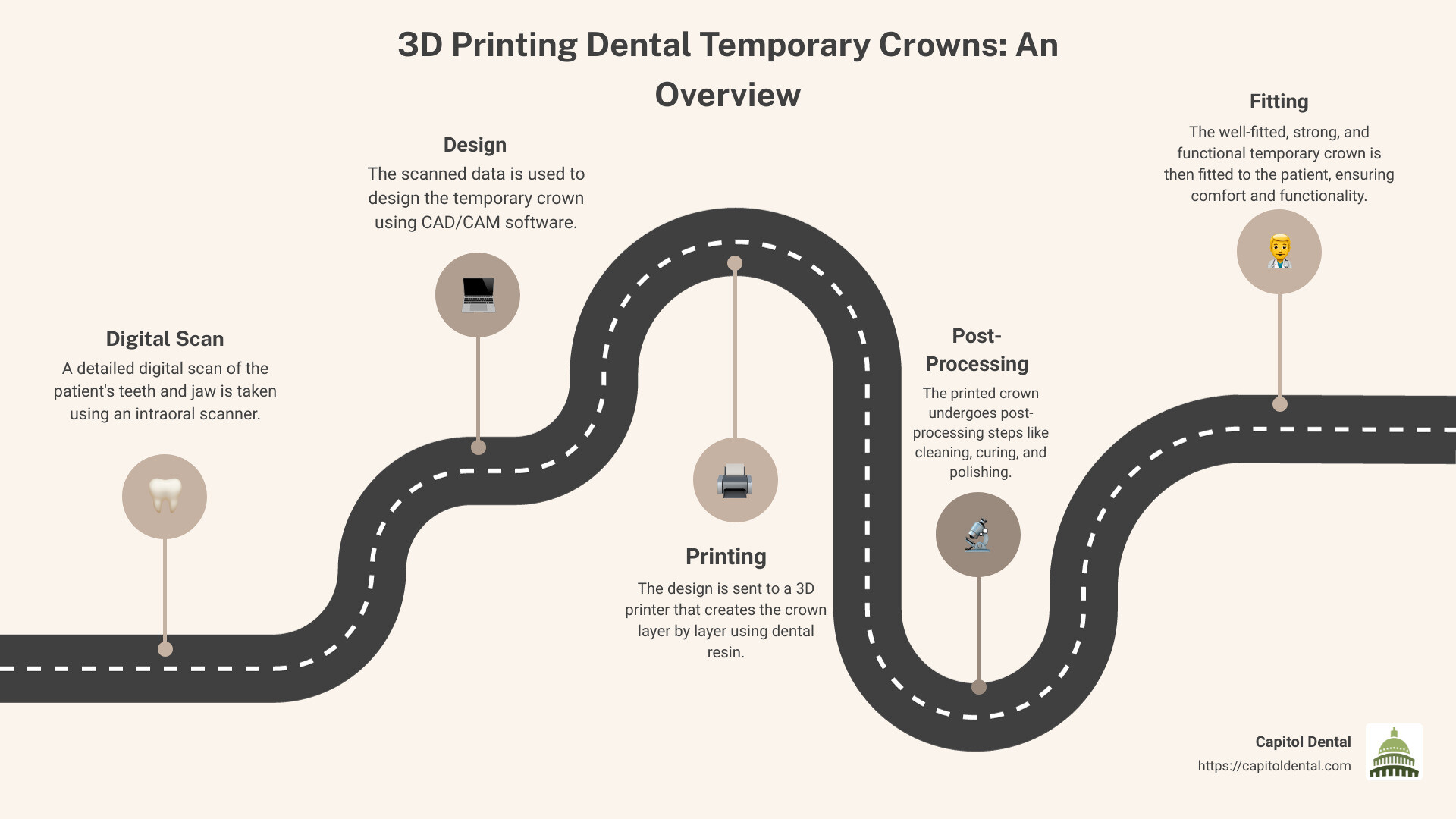
Here’s a quick overview of the process:
- Digital Scan: A detailed digital scan of the patient’s teeth and jaw is taken using an intraoral scanner.
- Design: The scanned data is used to design the temporary crown using CAD/CAM software.
- Printing: The design is sent to a 3D printer that creates the crown layer by layer using dental resin.
- Post-Processing: The printed crown undergoes post-processing steps like cleaning, curing, and polishing before it is fitted.
This process ensures that patients receive a well-fitted, strong, and functional temporary crown, minimizing discomfort and enhancing the overall dental experience.
Understanding 3D Printing in Dentistry
Benefits of 3D Printing Temporary Crowns
3D printing dental temporary crowns brings several benefits to both dentists and patients. Here’s a closer look at why this technology is revolutionizing dental care:
Cost-Effective
Traditional methods of creating temporary crowns involve multiple steps and often require outsourcing to dental labs. This can be expensive and time-consuming.
With 3D printing, dentists can produce crowns in-house, significantly reducing costs. Dr. Shao shared that by investing in a 3D printer, he saved money by bypassing external labs and even recouped his investment on the first complex case.
Quick Production
Speed is another critical advantage. Traditional crowns can take weeks to produce, but 3D printing reduces this time to mere hours.
For example, SprintRay’s 3D printers have drastically cut down production times, meaning patients spend less time waiting for their crowns. By digitizing each step of the process, days and weeks turn into hours.
High-Quality Materials
The materials used in 3D printing have advanced significantly. Dental resins now offer better rigidity and flexural strength than traditional PMMA.
Temp C&B UV 2.0 is a biocompatible resin developed specifically for temporary crowns and bridges. It offers exceptional strength and color stability over time, making it ideal for dental applications.
Patient Satisfaction
Customization and precision are key to patient satisfaction. Each crown can be tailored to fit the exact specifications of a patient’s mouth, ensuring a perfect fit.
Dr. Ali Saeghi noted that ceramic crowns produced using 3D printing can be matched precisely to the shade of surrounding teeth, providing a natural look. The precision of digital impressions and 3D printing ensures a level of accuracy slightly above milled or hand-fabricated prosthetics.
Conclusion
The benefits of 3D printing temporary crowns include cost-efficiency, quick production, high-quality materials, and improved patient satisfaction. These advantages make 3D printing an increasingly attractive option for dental practices.

Next, let’s explore the step-by-step guide to 3D printing dental temporary crowns, starting with scanning the patient’s dentition.
Step-by-Step Guide to 3D Printing Dental Temporary Crowns
Step 1: Scanning the Patient’s Dentition
The first step in 3D printing dental temporary crowns is to capture a digital impression of the patient’s teeth. This is done using an intraoral scanner (IOS).
- Upper Arch: The dentist scans the upper set of teeth.
- Lower Arch: The lower set of teeth is scanned next.
- Bite: Finally, the dentist captures the patient’s bite to ensure proper occlusion.
This digital impression provides a precise 3D model of the patient’s dentition, eliminating the need for traditional molds. The scans serve as the foundation for designing the temporary crown.
Step 2: Designing the Temporary Crown
Once the digital scans are complete, the next step is to design the crown using CAD/CAM software like 3Shape or ExoCAD.
- Import Scans: The digital impression files are imported into the design software.
- Design the Crown: Using the software, the dentist or a digital design provider creates the crown. The software shows how the crown will fit with the existing teeth.
- Export STL File: Once the design is finalized, it is exported as an STL file, which is the standard format for 3D printing.
Tip: Dentists can also outsource the design to a digital design provider to save time and ensure quality.
Step 3: Printing the Temporary Crown
With the STL file ready, it’s time to print the crown.
- Nesting Software: The STL file is imported into nesting software, which prepares the file for printing.
- Select Material: Choose a high-quality dental resin like Temporary CB Resin.
- Print: The file is sent to a 3D printer. The printer builds the crown layer by layer, a process that can take less than 20 minutes.
Pro Tip: Position the crown horizontally with the occlusal plane facing the build platform for optimal accuracy.
Step 4: Post-Processing the Printed Crown
After printing, the crown needs to go through post-processing to ensure it is ready for use.
- Cleaning: Remove the printed crown from the build platform and clean it in a Form Wash or similar device.
- Curing: Cure the crown using a Form Cure unit to harden the resin.
- Support Removal: Carefully remove any supports using a part removal tool.
- Finishing: Use hand tools to smooth out any rough edges.
- Polishing: Polish the crown to a realistic shine, ensuring it looks natural.
By following these steps, dentists can efficiently produce high-quality temporary crowns that meet patient needs quickly and accurately. This process not only saves time but also enhances patient satisfaction by providing a seamless experience.
Next, let’s discuss the materials and equipment needed for 3D printing dental temporary crowns.
Materials and Equipment Needed
To get started with 3D printing dental temporary crowns, you’ll need specific materials and equipment. Here’s a breakdown of what you’ll need:
3D Printer
A reliable 3D printer is crucial for creating precise dental crowns. Formlabs SLA printers like the Form 2 or Form 3B+ are highly recommended. These printers use stereolithography (SLA) to produce high-detail, accurate prints ideal for dental applications.
Dental Resin
The resin you choose affects the quality and durability of the crown. Temporary CB Resin is a popular choice for temporary crowns due to its strength and aesthetic qualities. It’s available in four VITA shades and is designed for up to seven-unit bridges. Another option is SprintRay Crown, known for its durability and biocompatibility. For long-lasting and sturdy temps, Saremco Crowntec resin is also highly recommended.
Intraoral Scanner
An intraoral scanner captures a digital impression of the patient’s dentition. This is the first step in the 3D printing workflow. Devices like the Medit Scan provide high-resolution, accurate images that are essential for creating well-fitting crowns.
CAD/CAM Software
Computer-Aided Design (CAD) and Computer-Aided Manufacturing (CAM) software are used to design the crown. Popular options include 3Shape and ExoCAD. These programs allow for detailed customization and export the design as an STL file, which is the standard format for 3D printing.
Curing Unit
After printing, the crown needs to be cured to solidify and strengthen the material. A curing unit like the Form Cure from Formlabs ensures that the resin reaches its optimal mechanical properties.
Additional Tools
- Nesting Software: This software prepares the STL file for printing by arranging the design within the printer’s build volume.
- Isopropyl Alcohol (IPA): Used for cleaning the printed crown to remove any residual resin.
- Polishing Tools: Essential for finishing the crown to achieve a natural look and feel.
By using the right combination of these materials and equipment, dental practices can produce high-quality temporary crowns efficiently and cost-effectively.
Next, let’s explore the recommended 3D printers and resins in more detail.
Frequently Asked Questions about 3D Printing Dental Temporary Crowns
Can you 3D print temporary crowns?
Yes, you can 3D print temporary crowns. With SprintRay Cloud Design, dentists can use intraoral scan data to create precise digital models of a patient’s teeth. This data is then used to design and print temporary crowns right in the office. This means that patients can get their temporary crowns in just one visit, without the need to wait for an external lab to produce them.
In-office production is a game-changer. It allows dental practices to provide quick and efficient care. The whole process, from scanning to fitting the crown, can be completed in a matter of hours.
How much does a 3D printed crown cost?
3D printed crowns are generally more affordable than traditional crowns. Traditional crowns often involve higher material costs and labor costs due to the need for external lab work. In contrast, 3D printing reduces these expenses significantly.
For example, the materials used in 3D printing, like SprintRay Crown, are cost-effective, usually around $2 per crown. Additionally, the labor costs are lower because the entire process is streamlined and done in-house. This makes 3D printed crowns a budget-friendly option for both dental practices and patients.
Are 3D printed crowns good?
3D printed crowns are a great option for temporary use. They offer high-quality materials that are durable and biocompatible. While they may not be as long-lasting as traditional crowns like ceramic or metal, they can last up to five years with proper care.
Many patients appreciate the convenience and speed of getting a 3D printed crown. The materials used, such as SprintRay Crown by BEGO, provide a good balance of strength and aesthetics, ensuring patient satisfaction. However, for long-term solutions, traditional crowns may still be the better choice due to their superior durability.
In summary, 3D printing dental temporary crowns is a cost-effective, quick, and efficient solution for both dentists and patients. The technology offers a high level of precision and quality, making it an excellent option for temporary restorations.
Next, let’s explore the recommended 3D printers and resins in more detail.
Conclusion
At Capitol Dental, we are committed to leveraging advanced dental technology to provide the best possible care for our patients. Our use of 3D printing for dental temporary crowns is a testament to this commitment. By integrating cutting-edge technology into our practice, we ensure that our patients receive high-quality, efficient, and cost-effective dental solutions.
Comprehensive Dental Services
We offer a wide range of dental services, from cosmetic dentistry to general care. Our team is skilled in using the latest techniques and tools to enhance patient outcomes. Whether you need a temporary crown, a permanent restoration, or routine dental care, we have the expertise and technology to meet your needs.
Patient-Centric Care
Our priority is always the comfort and satisfaction of our patients. With the rapid advancements in 3D printing technology, we can now offer quicker turnaround times and more precise fittings for temporary crowns. This means fewer visits to the dentist and less waiting time for our patients.
Why Choose Capitol Dental?
- Advanced Technology: We utilize state-of-the-art equipment, including 3D printers, intraoral scanners, and CAD/CAM software, to provide top-notch dental care.
- Expert Team: Our dentists are highly trained and experienced in the latest dental procedures and technologies.
- Patient Satisfaction: We focus on delivering personalized care that meets the unique needs of each patient, ensuring high levels of satisfaction and comfort.
Ready to experience the future of dentistry with 3D printed dental temporary crowns? Visit our Boise Cosmetic Dentistry page to learn more and schedule an appointment.
At Capitol Dental, your smile is our top priority. Let us help you achieve the perfect smile with our advanced dental solutions.