



How Long Do 3D Printed Crowns Last? Top 3 Surprising Facts
Introduction
How long do 3D printed crowns last? With proper care, 3D printed crowns can last 10 to 15 years, similar to traditional crowns.
3D printing technology is revolutionizing dental care, especially in the creation of dental crowns. Capitol Dental is at the forefront of this innovation, offering patients precise, durable, and custom-fitted crowns faster than ever before.
Gone are the days when you had to wait weeks for a dental crown. With 3D printing, Capitol Dental can design and produce a crown during a single visit. This not only saves time but also reduces costs for both patients and the practice.
The Evolution of 3D Printing in Dentistry
3D printing technology has come a long way since its early days. Initially, it was a fringe technology, but it has steadily moved into the mainstream due to its increasing affordability and reliability. In dentistry, this evolution has been particularly transformative.
Precision
One of the standout benefits of 3D printing in dentistry is its precision. Traditional methods often involved multiple steps, each introducing a potential for error. With 3D printing, the process is streamlined and highly accurate. Digital impressions taken with intraoral scanners capture every detail of a patient’s mouth. These digital models are then used to create dental crowns with near-perfect precision.
Mainstream Technology
What started as a novel concept is now becoming a standard practice. The technology has advanced to the point where dental practices can affordably integrate 3D printers into their workflows. This shift is making 3D printing a mainstream technology in dentistry. For instance, popular 3D printers like the Formlabs Form printers and Shining3D’s AccuFab Printers are now commonly used in dental offices.
Early Implementations
Early implementations of 3D printing in dentistry were primarily focused on creating diagnostic models and surgical guides. These tools required high precision but not necessarily the strength needed for permanent dental restorations. Diagnostic models help dentists plan treatments more accurately, while surgical guides ensure that procedures like implant placements are performed with greater precision.

Surgical Guides
Surgical guides are one of the most critical applications of 3D printing in dentistry. These guides are custom-made for each patient, ensuring that dental implants and other surgical procedures are carried out with pinpoint accuracy. The use of 3D printed surgical guides has significantly improved the outcomes of complex dental surgeries.
Dr. Shao, a dentist who adopted 3D printing early, shared that the technology helped him produce precise surgical guides and mockups. This not only saved time but also convinced patients to proceed with complex treatments by showing them exact replicas of the final results.
In summary, 3D printing has transformed from a niche technology to an essential tool in modern dentistry. Its precision, affordability, and versatility make it an invaluable asset for dental professionals and patients alike.
Next, we’ll delve into how long 3D printed crowns last and what factors influence their durability.
How Long Do 3D Printed Crowns Last?
Factors Influencing the Lifespan of 3D Printed Crowns
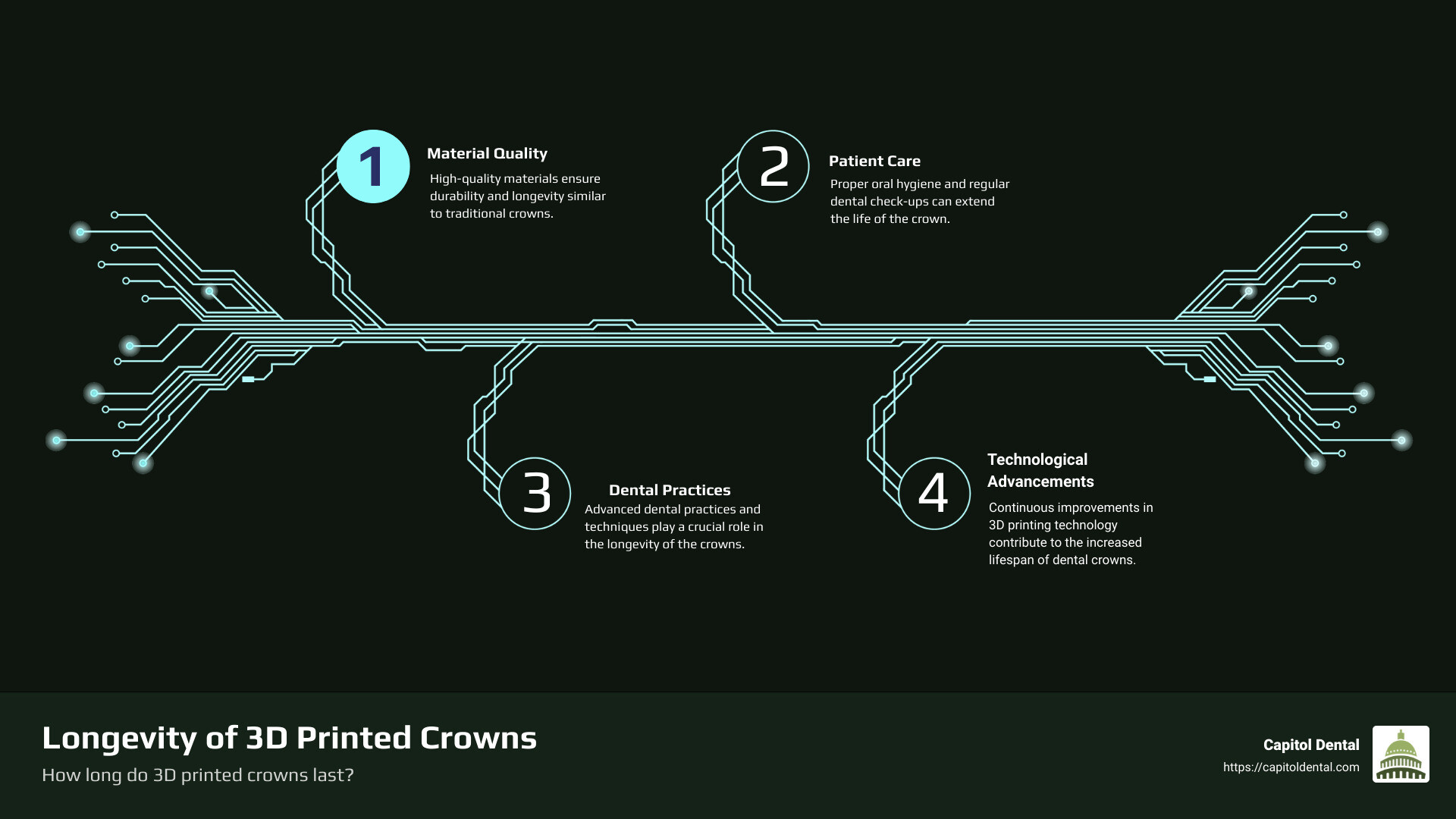
The durability of 3D printed crowns depends on several key factors. First, the quality of the material used plays a significant role. High-performance dental resins, like Saremco Crowntec, are stronger than traditional PMMA and designed for long-term use. However, these materials still lag behind traditional options like zirconia in terms of longevity.
Patient care is another crucial factor. Proper oral hygiene—brushing twice daily, flossing, and regular dental check-ups—can extend the lifespan of a 3D printed crown. Patients who maintain good oral hygiene are better candidates for these crowns.
Lastly, the dental practice’s expertise and equipment quality influence durability. Practices that use advanced nesting software and curing units ensure better results. For instance, a well-cured crown will be more robust and less prone to fractures.
Comparing Lifespan: 3D Printed vs. Traditional Crowns
When comparing 3D printed crowns to traditional crowns, the difference in durability is clear. Traditional crowns made from zirconia or eMax can last over five years, often extending to 10-15 years with proper care. These materials are known for their strength and aesthetic appeal, making them the gold standard for permanent solutions.
In contrast, most 3D printed crowns are currently suitable for temporary use. They provide a quick, cost-effective solution while waiting for a more durable crown. For instance, temporary crowns made from composite resin can last a few months to a year.
However, advancements in 3D printing technology are closing the gap. With ongoing improvements in material science, the future may see 3D printed crowns that match the durability of traditional options.
Technological Advancements and Future Prospects
The future of 3D printed crowns looks promising. Advances in material science are leading to stronger, more durable resins. For example, the integration of ceramic particles into dental resins could enhance both the strength and aesthetic quality of 3D printed crowns.
Industry predictions suggest that within the next few years, 3D printing technology will evolve to produce crowns that rival traditional materials in both durability and appearance. According to TechRadar, companies like Formlabs are developing specialized 3D printers and resins that could revolutionize dental care.
In summary, while 3D printed crowns currently serve as excellent temporary solutions, ongoing technological advancements are set to improve their lifespan and quality, making them a viable option for permanent restorations in the near future.
Next, we’ll explore the aesthetic and functional considerations of 3D printed crowns, focusing on how they compare to traditional crowns in terms of fit, comfort, and visual appeal.
Aesthetic and Functional Considerations of 3D Printed Crowns
The Role of Aesthetics in Dental Restorations
One of the key benefits of 3D printed crowns is personalization. Each crown is designed using digital impressions and CAD software, which allows for a precise fit tailored to the unique contours of a patient’s mouth. This ensures not only comfort but also functionality that closely mimics natural teeth.
However, there are shade limitations. Currently, most 3D printers can produce crowns in a single shade at a time. This often results in crowns that appear monochromatic and lack the natural translucency and color variations found in real teeth.
Despite these limitations, the visual appeal of 3D printed crowns is improving. Innovations in ceramic-filled printable materials are showing great potential for better color matching and aesthetic quality. For instance, companies like Lithoz are developing new ceramic-dominant resins that offer higher strength and improved aesthetics.
Functional Aspects: Fit and Comfort
When it comes to functionality, the fit and comfort of 3D printed crowns are major advantages. The precise fabrication process ensures that the crowns fit perfectly over the prepared tooth, avoiding any pressure points or discomfort. This leads to a more secure fit and better bite force distribution, which helps in preventing localized pressure points and ensuring patients can chew and speak with ease.
Moreover, the smoother finish achieved with 3D printing minimizes irritation to the surrounding soft tissues, promoting better gum health. This is crucial for patient satisfaction, as it enhances both the comfort and longevity of the restoration.
While 3D printed crowns may not yet match the aesthetic quality of traditional ceramic crowns, they offer significant benefits in terms of personalization, fit, and comfort. These factors contribute to a more functional and natural-looking smile, ultimately improving patients’ oral health and well-being.
Next, we’ll delve into a detailed cost analysis of 3D printed crowns versus traditional methods, examining the economic benefits for both patients and clinics.
Cost Analysis: 3D Printed Crowns vs. Traditional Methods
Breaking Down the Costs
When it comes to cost-efficiency, 3D printed crowns have a clear edge over traditional methods. Traditional crowns often involve multiple steps: taking impressions, sending them to a lab, and waiting for the crown to be made. This process can be both time-consuming and expensive.
Material Costs:
– Traditional Crowns: Typically made from metal or ceramic, which can be costly.
– 3D Printed Crowns: Use resin or composite materials that are generally less expensive and reduce material waste. For instance, the Permanent Crown Resin costs about $1.25/mL, with a single crown using just 0.58mL.
Labor Costs:
– Traditional Crowns: Require skilled technicians to fabricate the crowns, adding to the labor costs.
– 3D Printed Crowns: The process is more automated, reducing the need for extensive manual labor. A dentist can design and print the crown in-house, cutting out the middleman.
Overhead Costs:
– Traditional Crowns: Incur additional costs for lab fees and shipping.
– 3D Printed Crowns: Eliminate these extra costs, as everything is done on-site.
Economic Benefits for Patients and Clinics
Savings:
– Patients save on multiple visits and temporary crowns, which are often necessary with traditional methods.
– Clinics benefit by reducing overhead costs and increasing the number of patients they can serve.
Same-Day Procedures:
3D printing allows for same-day procedures, significantly reducing the waiting time for patients. According to Mike Jafar, CEO of Desktop Health, “With our technology, patients can go home the same day with their permanent prosthetic.”
Reduced Clinic Visits:
Patients appreciate fewer visits to the clinic. This not only saves time but also reduces the overall cost of treatment. Shao, a dentist using 3D printers, noted that he made back his investment on the very first complex case, highlighting both the speed and cost-effectiveness of 3D printing.
In summary, the economic benefits of 3D printed crowns are substantial for both patients and clinics. The reduction in material, labor, and overhead costs, combined with the ability to complete procedures in a single visit, makes 3D printing an attractive option.
Next, we will address frequently asked questions about 3D printed dental crowns to provide further insights and clear any lingering doubts.
Frequently Asked Questions about 3D Printed Dental Crowns
How good are 3D printed crowns?
Durability: 3D printed crowns are a good temporary solution but may not be as durable as traditional milled crowns like zirconia or eMax. They can last up to five years but are more prone to wear and tear, especially in areas with high biting forces.
Material Quality: The quality of materials used in 3D printed crowns has improved. Modern resins, like Permanent Crown Resin, offer high strength and biocompatibility. However, they still fall short compared to ceramic or metal crowns in terms of long-term durability.
Patient Satisfaction: Many patients appreciate the convenience of same-day crowns and the comfort of avoiding traditional impressions. However, some may find the aesthetics and durability of 3D printed crowns lacking compared to traditional options.
What materials are used in 3D printed dental crowns?
3D printed dental crowns are primarily made from composite resin. This resin is a type of plastic that is strong and biocompatible. Some advanced resins, like the Permanent Crown Resin, offer higher strength and better durability.
The resin is cured using UV light to harden it into a solid object. This process ensures that the crown is strong enough to withstand daily use. However, it is still not as durable as materials like zirconia or eMax, which are used in traditional milled crowns.
Can 3D printed crowns be used as a permanent dental solution?
Currently, 3D printed crowns are best suited for temporary use. They can last up to five years, making them a great interim solution. However, they are not yet on par with traditional crowns for long-term use. Traditional crowns, such as ceramic or metal, can last 15 years or more with proper care.
Future advancements in materials and technology may improve the durability of 3D printed crowns. For now, they are an excellent option for temporary fixes, especially when time and cost are significant factors.
Next, we will delve into the aesthetic and functional considerations of 3D printed crowns, exploring their personalization, design precision, and fit.
Conclusion
As we look to the future of dental technology, the potential for 3D printing in dentistry is vast. At Capitol Dental, we are committed to staying at the forefront of these advancements. Our goal is to offer our patients the best possible care, leveraging the latest innovations to enhance their oral health and well-being.
Embracing Innovation
3D printing technology has already revolutionized many aspects of dentistry. From creating highly accurate dental crowns to producing surgical guides and night guards, the possibilities are endless. The speed and precision of 3D printing mean that patients can receive customized solutions faster than ever before.
Patient-Centered Care
Our focus at Capitol Dental is always on patient-centered care. We understand that every patient is unique, and their dental needs are too. By incorporating 3D printing technology, we can provide personalized treatments that are tailored to each patient’s specific requirements. This ensures not only a better fit and comfort but also improved aesthetic outcomes.
The Future is Bright
The future of dental technology is promising, with continuous innovations on the horizon. As material science advances, we anticipate that the durability and functionality of 3D printed crowns will only improve. This will make them an even more viable option for long-term dental restorations.
At Capitol Dental, we are excited to be part of this journey. By embracing these cutting-edge technologies, we can provide our patients with the highest quality dental care. Your smile is our priority, and we look forward to helping you achieve and maintain excellent oral health.
For more information about our cosmetic dentistry services and how we utilize 3D printing technology, visit our cosmetic dentistry page.
By staying updated with the latest trends and continuously improving our practices, we ensure that our patients receive the best care possible. The integration of 3D printing in dentistry is just one example of how we are dedicated to innovation and excellence in patient care.